Let’s Build Something Great
Tell us about your goals and request a free project estimate.


Search engine discovery has traditionally been slow. When you publish new content or update an existing page, you wait for search engine crawlers to find it. That process can take days or even weeks, depending on your site’s crawl frequency and authority.
The limitations of waiting for crawlers are obvious: fresh content remains undiscovered, time-sensitive updates miss their window, and you watch competitors appear in search results while your pages sit in a crawl queue. Traditional discovery relies on a pull model-search engines decide when to check your site, not when you update it.
IndexNow solves this problem. It is a push protocol that lets you notify participating search engines the moment your content changes. Instead of waiting for a crawler to discover your URL, you tell search engines about it immediately.
IndexNow is an open protocol that allows website owners to instantly inform search engines about the latest content changes on their websites. It was launched by Microsoft (Bing) and Yandex in 2021.
The protocol is offered under open terms. When you submit a URL to any one participating search engine, that engine forwards the notification to all other participating engines within roughly 10 seconds. This means you only need to submit to one endpoint to reach all supported search engines.
IndexNow was created to address several fundamental problems with traditional crawling:
As of 2026, IndexNow is supported by the following search engines:
| Search Engine | Endpoint | Notes |
|---|---|---|
| Bing | https://www.bing.com/indexnow | Primary adopter, best documented |
| Yandex | https://yandex.com/indexnow | Active participant |
| Seznam.cz | https://search.seznam.cz/indexnow | Czech market |
| Naver | https://searchadvisor.naver.com/indexnow | South Korean market |
| Yep | https://indexnow.yep.com/indexnow | Privacy-focused search engine |
Important: Google does not support IndexNow as of 2026, despite testing the protocol since October 2021. Google uses its own crawl scheduling systems and recommends XML sitemap submission and internal linking for content discovery.
IndexNow has achieved significant adoption:

This pull-based approach relies on search engines discovering changes on their own schedule. Discovery can take days or even weeks.
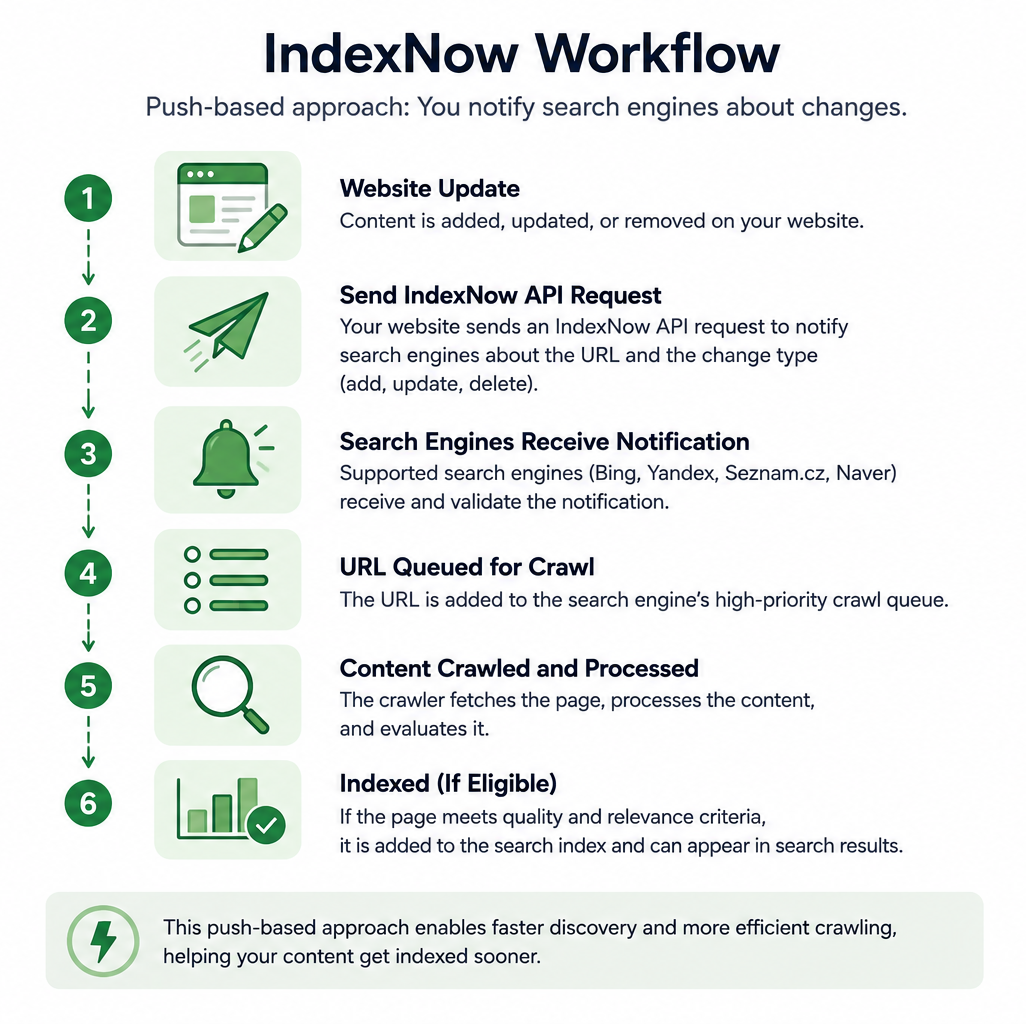
With IndexNow, you push the notification immediately when content changes. This typically reduces discovery latency from days to hours.
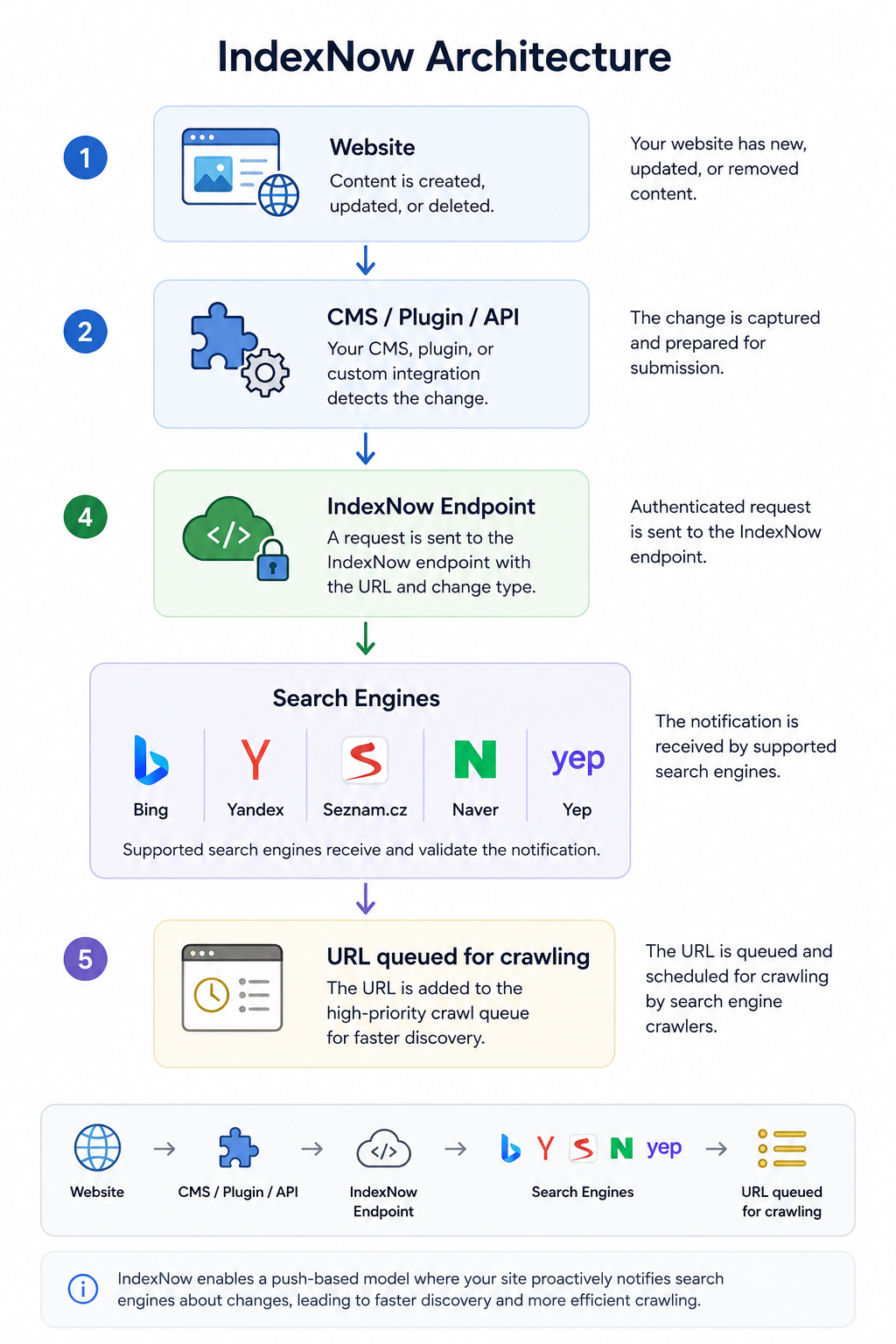
When you submit to any one participating search engine, the submission is automatically shared with all others.
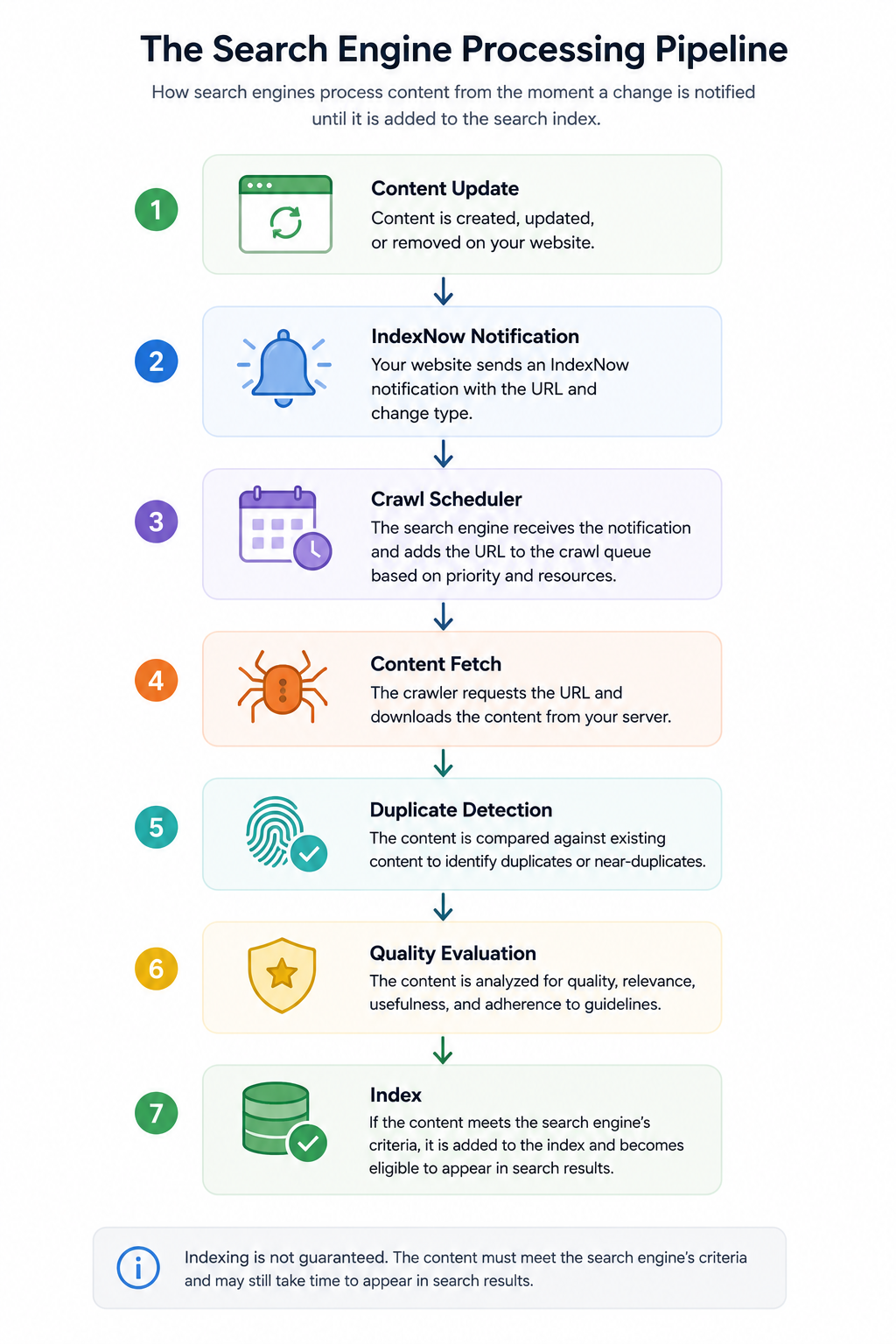
Important: IndexNow does NOT guarantee indexing. It notifies search engines that a URL has changed-it does not bypass quality signals or guarantee inclusion in search results.
| Aspect | XML Sitemap | IndexNow |
|---|---|---|
| Purpose | Discovery | Notification |
| Model | Pull (search engine fetches) | Push (site sends notification) |
| Crawl frequency | Days to weeks | Minutes to hours |
| Updates | Periodic (when sitemap regenerates) | Immediate (when content changes) |
| Batch support | Entire site | Up to 10,000 URLs per request |
| Infrastructure | Static file | API endpoint |
| Search engine support | All major engines | Bing, Yandex, Seznam, Naver, Yep |
XML sitemaps and IndexNow are complementary, not competitive. You should use both. Sitemaps provide baseline discovery for all URLs; IndexNow provides real-time notification for changed URLs.
| Aspect | Google Indexing API | IndexNow |
|---|---|---|
| Supported content | JobPosting and BroadcastEvent only | Any URL |
| Search engines | Google only | Bing, Yandex, Seznam, Naver, Yep |
| Eligibility | Requires structured data | No special requirements |
| Limitations | Limited to specific content types | No content type restrictions |
Google’s Indexing API is limited to JobPosting and BroadcastEvent structured data. IndexNow has no such restrictions.
IndexNow supports both single URL submissions and batch submissions.
Global endpoint: https://api.indexnow.org/indexnow
Search engine-specific endpoints:
| Engine | Endpoint |
|---|---|
| Bing | https://www.bing.com/indexnow |
| Yandex | https://yandex.com/indexnow |
| Seznam | https://search.seznam.cz/indexnow |
| Naver | https://searchadvisor.naver.com/indexnow |
| Yep | https://indexnow.yep.com/indexnow |
To use IndexNow, you must prove ownership of your domain:
.txt.https://yourdomain.com/{your-key}.txt.Example: If your key is 94f18d99d0144ff09da36d530b7c56ff, create 94f18d99d0144ff09da36d530b7c56ff.txt in the root of your site.
GET https://www.bing.com/indexnow?url=https://www.example.com/product.html&key=94f18d99d0144ff09da36d530b7c56ffParameters:
url: The URL that has been added, updated, or deleted (must be URL-encoded and follow RFC-3986)key: Your API key (8-128 hexadecimal characters)keyLocation: (Optional) Location of your key file if not at the rootSubmit up to 10,000 URLs per POST request:
POST /indexnow
Content-Type: application/json; charset=utf-8
Host: www.bing.com
{
 "host": "www.example.com",
 "key": "94f18d99d0144ff09da36d530b7c56ff",
 "keyLocation": "https://www.example.com/myIndexNowKey63638.txt",
 "urlList": [
 "https://www.example.com/url1",
 "https://www.example.com/folder/url2",
 "https://www.example.com/url3"
 ]
}
You can mix HTTP and HTTPS URLs if needed.
| Code | Meaning |
|---|---|
| 200 | Success-search engine has received your URL(s) |
| 202 | Accepted for processing |
| 400 | Bad request-invalid format or parameters |
| 403 | Forbidden-key verification failed |
| 429 | Too many requests-rate limiting |
| 500 | Internal server error |
The HTTP 200 response code only indicates that the search engine has received your URL. It does not guarantee indexing.
After you submit a URL via IndexNow:
Important: IndexNow notifies search engines of changes-it does not influence rankings. A thin page that would not rank will still not rank. IndexNow just makes the crawler aware of it faster.
| Benefit | Explanation |
|---|---|
| Faster discovery | Reduces discovery latency from days to hours |
| Lower crawl waste | Search engines only crawl changed URLs |
| Better freshness | New content appears in search results sooner |
| Less server load | Fewer unnecessary crawls |
| Improved indexing efficiency | Search engines prioritise what matters |
| Better for news sites | Time-sensitive content gets indexed faster |
| Better for e-commerce | Inventory and price changes propagate quickly |
| Better for large websites | Ensures all pages are discovered |
IndexNow has several important limitations:
IndexNow is most valuable for:
| Use Case | Why |
|---|---|
| News websites | Time-sensitive content needs immediate indexing |
| E-commerce | Inventory, price, and availability changes |
| Frequently updated blogs | New posts should appear quickly |
| Classified websites | Listings have short lifespans |
| Marketplaces | New products and sellers need discovery |
| Documentation | Versioned documentation updates |
| SaaS platforms | Changelog and feature updates |
Rule of thumb: If your content has a half-life measured in hours or days, IndexNow pays off. If your content is evergreen and well-linked, it’s nice to have but not urgent.
Popular plugins include:
Installation is straightforward: search for the plugin in the WordPress admin, install, activate, and configure.
Playful Sparkle offers an IndexNow extension for OpenCart 3.x and 4.x. Download from the OpenCart Marketplace, install via the admin panel’s Extensions > Installer, and configure.
$url = 'https://www.bing.com/indexnow?url=' . urlencode($pageUrl) . '&key=' . $apiKey;
$ch = curl_init($url);
curl_setopt($ch, CURLOPT_RETURNTRANSFER, true);
$response = curl_exec($ch);
$httpCode = curl_getinfo($ch, CURLINFO_HTTP_CODE);
curl_close($ch);
if ($httpCode === 200) {
 // Success
}const https = require('https');
const options = {
hostname: 'www.bing.com',
path: '/indexnow?url=' + encodeURIComponent(url) + '&key=' + apiKey,
method: 'GET'
};
const req = https.request(options, (res) => {
if (res.statusCode === 200) {
// Success
}
});
req.end();import requests
url = f"https://www.bing.com/indexnow?url={page_url}&key={api_key}"
response = requests.get(url)
if response.status_code == 200:
# SuccessImplement IndexNow by:
Automatically notify supported search engines whenever products, categories, manufacturers, information pages, or articles are created, updated, or removed. IndexNow for OpenCart 3.x+ and 4.x+ helps reduce content discovery delays through automated URL submissions, flexible queue management, and comprehensive monitoring tools.
Use these tools to monitor IndexNow performance:
| Mistake | Why It’s a Problem | Fix |
|---|---|---|
| Missing key file | Ownership cannot be verified | Upload key file to root directory |
| Wrong endpoint | Submission goes to the wrong search engine | Use correct endpoint for your target engine |
| Sending unchanged URLs | Wastes search engine resources | Only submit changed URLs |
| Invalid JSON | Batch submissions fail | Validate JSON before sending |
| Wrong host | Key verification fails | Ensure host matches the domain in the URL |
| HTTP instead of HTTPS | Security requirements | Use HTTPS for all requests |
| Method | Type | Speed | Search Engine Support | Best For |
|---|---|---|---|---|
| XML Sitemap | Pull | Days to weeks | All major | Full site coverage |
| RSS Feed | Pull | Hours to days | Limited | Content aggregators |
| robots.txt | Pull | N/A | All | Crawl instructions |
| Internal linking | Pull | Days to weeks | All | Crawl path architecture |
| Google Indexing API | Push | Hours | Google only | JobPosting, BroadcastEvent |
| Manual submission | Push | Hours | Individual | One-off submissions |
| IndexNow | Push | Minutes to hours | Bing, Yandex, Seznam, Naver, Yep | Time-sensitive updates |
IndexNow modernises URL discovery by shifting from passive crawling to active notifications. Instead of waiting for search engines to find your content, you tell them about it immediately.
However, IndexNow is not a replacement for other SEO fundamentals. It should be part of a broader technical SEO strategy alongside XML Sitemaps, robots.txt, internal linking, and high-quality content. IndexNow notifies search engines of changes; it does not replace the need for crawlable architecture, discoverable content, or quality signals.
The protocol has achieved significant adoption-3.5 billion URLs are submitted daily, and IndexNow is responsible for 22% of all clicked Bing URLs. With native integration in major platforms like WordPress, Shopify, and Cloudflare, implementation has never been easier.
The one notable gap is Google. Despite testing the protocol since 2021, Google has not adopted IndexNow. For sites primarily optimising for Google, IndexNow remains an add-on for Bing visibility and AI platforms that use the Bing index (particularly ChatGPT Search).
For sites with frequently updated content, e-commerce inventory, news articles, or any time-sensitive material, IndexNow provides a measurable advantage in discovery speed. It is free, well-documented, and increasingly supported across the web ecosystem.
Need help implementing IndexNow on your website? Playful Sparkle has been engineering digital products since 2004, offering SEO & Digital Marketing, Web Development, and technical consulting services. Our team can help you implement IndexNow, configure XML Sitemaps, and optimise your technical SEO strategy. Contact us to discuss how we can help you improve your search visibility.



The EU AI Act’s Article 50 transparency rules apply from 2 August 2026. Learn which AI systems are covered, what businesses must disclose, key deadlines, penalties, and the latest compliance requirements.

Live streaming income guide 2026: Twitch vs YouTube vs TikTok requirements, revenue splits (70% YouTube, 50% Twitch default), income estimates (€ 3,000–€ 8,000/month full-time), and audience demographics.

YouTube changed its public view-counting system on August 24, 2026. Learn how first-frame views affect reporting, creator analytics, engagement metrics, and YouTube Partner Programme requirements.

