Let’s Build Something Great
Tell us about your goals and request a free project estimate.


Canva has become the default design tool for millions of entrepreneurs and small business owners. It offers templates, icons, fonts, and design elements that allow users to create logos quickly without hiring a professional designer. For startups with limited budgets, this sounds like an ideal solution.
However, a logo is not just a visual identifier. It is the cornerstone of your brand identity-the embodiment of your brand’s values, personality, and distinctiveness. This article examines why Canva falls short for logo design and why a professionally crafted, unique logo is essential for standing out in a competitive market.
<image> tags rather than <path> tags.Canva is a browser-based design tool built for producing graphics that look good on screen-social posts, presentations, marketing materials, and digital content. It excels at this. It has a massive library of templates, icons, and assets, and it makes graphic design accessible to non-designers.
What Canva is not: a professional vector illustration application. It does not build logos as mathematical paths the way Adobe Illustrator, Affinity Designer, or Inkscape do. When you create a logo in Canva, you are arranging pre-built raster elements on a canvas-not constructing vector paths.
This distinction is not academic. It has real consequences for how your logo can be used, protected, and scaled.
Canva templates are used by millions of people. According to Canva’s own Help Center, their logo templates are “customisable and can be used by anyone. This means that your rights to the logo are non-exclusive.”
When multiple businesses use the same template, icon, or font combination, the resulting logos are not unique. A logo created using a common template might be aesthetically pleasing, but if it resembles the logos of other brands, it fails to differentiate your business.
Canva’s official guidance is explicit: “Canva’s logo templates are customisable and can be used by anyone. This means that your rights to the logo are non-exclusive and you can’t register it as a trademark.”
For a logo to be trademarked, the elements in it need to be exclusive to you. Canva only grants non-exclusive licenses to stock content-other users are free to use the same content.
If you need to protect your brand legally, a Canva template-based logo is not suitable. If you design a logo from scratch in Canva using basic lines, shapes, and fonts from the Free library-without using stock photos or graphics-you may be able to trademark it. However, this requires genuine originality and avoids any template-based or stock elements.
Canva offers SVG export, and SVG is a vector format. However, Canva’s SVG export for logos typically contains embedded raster images inside an SVG wrapper-not actual vector paths.
A real vector SVG logo should be under 10KB. Canva SVGs are often 500KB–2MB. Opening them in Illustrator reveals embedded PNG images, not paths. The practical test: if you open a Canva SVG in a text editor and see <img> tags rather than <path> tags, it is raster content inside a vector container <path>.
Canva’s export options and their actual content:
| Export Format | What It Actually Contains | Suitable For |
|---|---|---|
| PNG | Raster image at specified pixel dimensions | On-screen use, small prints |
| PDF (Standard) | Raster images inside a PDF wrapper | Limited use |
| PDF (Print) | Higher-quality raster PDF with CMYK simulation | Not true vector |
| SVG | Often embedded raster images inside an SVG wrapper | Not true vector |
Logos need to work everywhere-from favicons to billboards. Canva exports logos as PNGs or basic vector files that tend to fall apart when resized. A logo that looks crisp on a website may become pixelated when stretched for a banner.
Canva’s SVG export is limited to a maximum resolution of 2000 × 2000 pixels. If you need higher resolution, you will need other design software or a more advanced vector editing tool.
Many Canva users do not realise how important colour modes (RGB versus CMYK) are for printing. A colour that appears vibrant on screen may print as a dull grey-blue on packaging.
Professional designers use CMYK colour profiles for print work, ensuring colour accuracy across different media. Canva’s colour management is optimised for screen display, not professional print production.
A well-designed logo is not just visually appealing-it tells a story about your brand. It communicates your brand’s values, mission, and personality. Creating a logo that captures this essence requires a deep understanding of your brand’s narrative, as well as the ability to distill that narrative into a single, memorable mark.
Canva’s template-based approach does not allow for this level of storytelling. It provides generic design elements that do not reflect the unique qualities of your brand. A professionally designed logo is crafted with your brand’s story in mind-every element, from colour scheme to typography and iconography, is carefully chosen to communicate your brand’s essence.
According to recent research, 75% of consumers recognise a brand by its logo. A distinctive, memorable logo is one of the most effective ways to build brand recall. Shape-based assets such as logos and packaging consistently perform best, with 40% fame and 71% uniqueness, whereas colour assets perform weakest, with 12% fame and 39% uniqueness.
Consistent logo use across all platforms is linked to a 23% increase in revenue. A professionally designed logo creates consistency across all brand touchpoints, reinforcing brand recognition and trust.
48% of consumers say that a logo, packaging, or digital brand presence influences their trust in a company. A polished, professional logo signals credibility and signals that your business is established and serious about its identity.
A professionally designed logo is built to last. Professional designers understand the importance of timeless design and will create a logo that can evolve with your brand. This future-proofs your brand and ensures your logo remains relevant and effective for years to come.
A custom-designed logo is versatile and can be used across a wide range of platforms and media, from digital to print. Professional designers provide different versions of your logo (horizontal, vertical, black and white, etc.) as well as the necessary file formats for various applications-ensuring your logo always looks its best.
Canva is not without value. It is an excellent tool for:
However, using Canva for your primary logo is a compromise that can limit your brand’s potential and create legal and technical problems down the road.
Canva’s own recommendation: “We recommend reaching out to a local graphic designer or artist instead” if you need exclusive rights to a graphic.
While Canva is a powerful tool for many design tasks, it falls short when it comes to creating a logo that truly represents your brand. A logo is one of the most important elements of your brand identity, and it deserves more than a quick, template-based design.
The limitations are clear: non-exclusive rights that prevent trademark registration, raster-based export formats that limit scalability, colour mode issues that affect print quality, and a lack of strategic brand storytelling. These are not minor inconveniences-they are fundamental constraints that can affect your brand’s legal protection, visual consistency, and long-term growth.
Investing in a custom-designed logo crafted by a professional graphic designer is an investment in your brand’s future. A unique, high-quality logo will help you stand out, build brand recognition, and effectively communicate your brand’s values and mission.
Need help creating a logo that builds your brand? Playful Sparkle has been engineering digital products since 2004, offering Branding & Strategy, UI/UX & Web Design, and Graphic & Visual Design services. Our team can help you develop a visual identity that drives recognition, trust, and growth. Contact us to discuss how we can help you build a brand that lasts.


The EU AI Act’s Article 50 transparency rules apply from 2 August 2026. Learn which AI systems are covered, what businesses must disclose, key deadlines, penalties, and the latest compliance requirements.
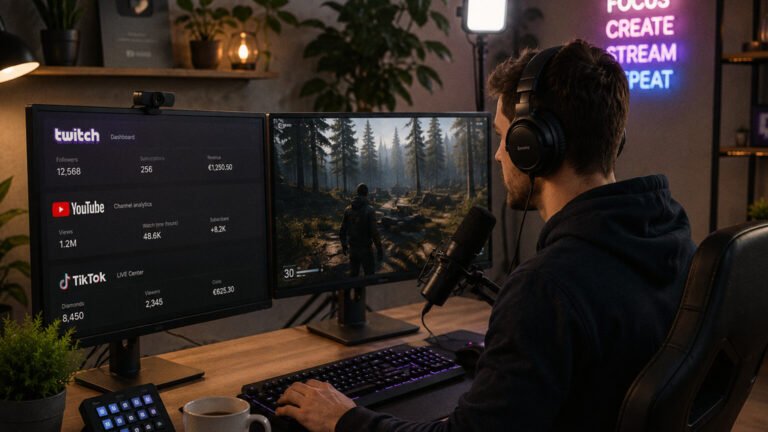
Live streaming income guide 2026: Twitch vs YouTube vs TikTok requirements, revenue splits (70% YouTube, 50% Twitch default), income estimates (€ 3,000–€ 8,000/month full-time), and audience demographics.

YouTube changed its public view-counting system on August 24, 2026. Learn how first-frame views affect reporting, creator analytics, engagement metrics, and YouTube Partner Programme requirements.

