Let’s Build Something Great
Tell us about your goals and request a free project estimate.


p=quarantine or p=reject) is mandatory for BIMI display. This makes BIMI a powerful incentive to complete your authentication journey.BIMI stands for Brand Indicators for Message Identification. It is an email specification that permits domain owners to coordinate with Mail User Agents (MUAs)-such as Gmail, Yahoo Mail, and Apple Mail-to display brand‑specific indicators (logos) next to properly authenticated messages.
The BIMI specification is currently an IETF Internet-Draft with an intended status of Standards Track, expected to be published as an RFC in late 2026. The draft is maintained by the AuthIndicators Working Group and is set to expire on 2 November 2026.
There are two aspects of BIMI coordination:
Domain owners communicate their desired indicators through the BIMI Assertion Record in DNS, and that record is interpreted by MTAs and MUAs.
BIMI sits at the intersection of email authentication and brand marketing. It provides:
BIMI adds a visible trust signal-your verified logo-next to authenticated emails. The process follows these steps:
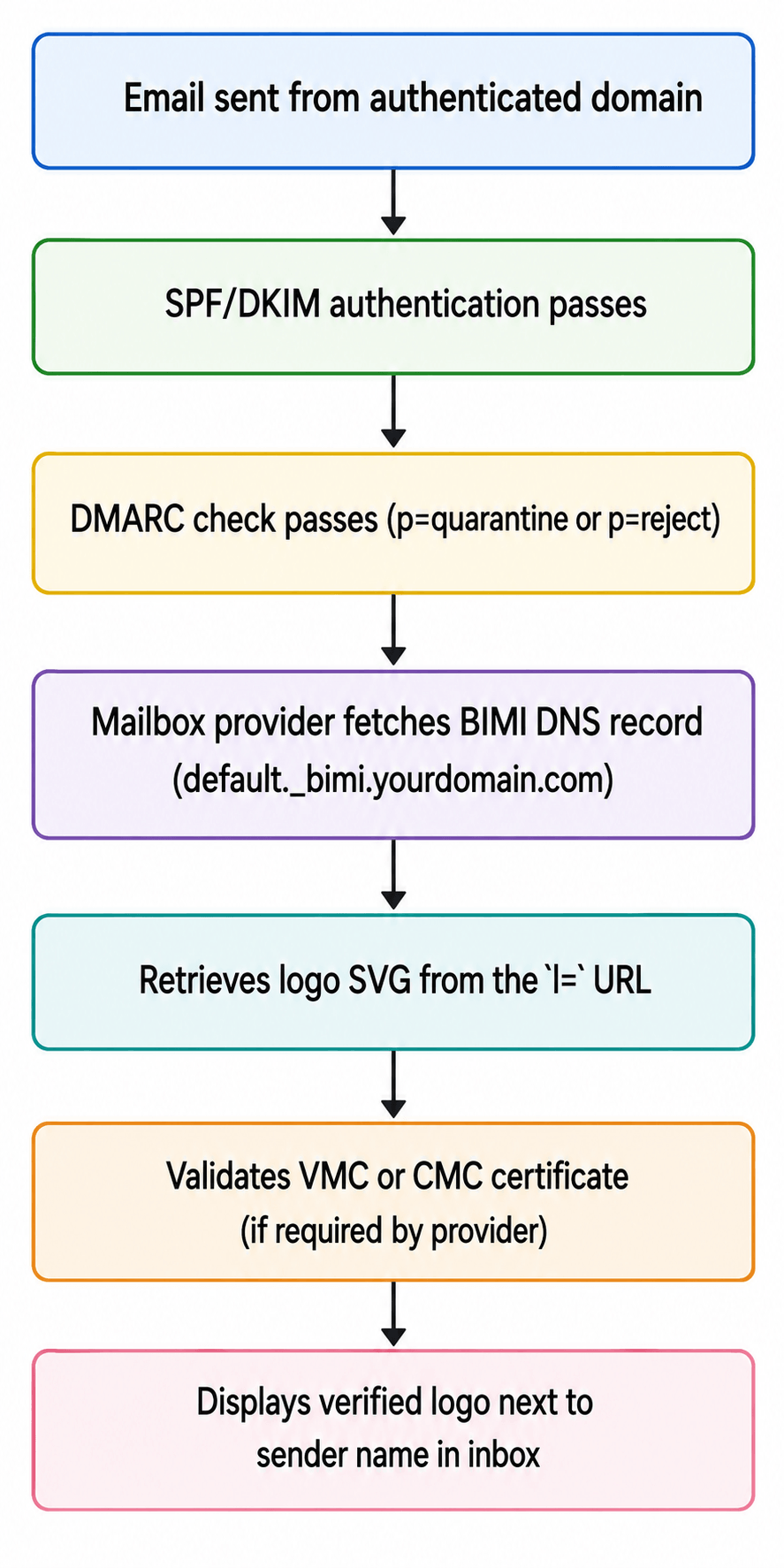
BIMI builds directly on existing email authentication protocols:
| Layer | Protocol | BIMI’s Role |
|---|---|---|
| Layer 1 | SPF | Authorises sending IPs |
| Layer 2 | DKIM | Cryptographic signing |
| Layer 3 | DMARC | Policy enforcement |
| Layer 4 | BIMI | Verified logo display |
BIMI is the newest layer, sitting on top of all three authentication protocols. Without DMARC enforcement, BIMI cannot function.
DMARC at p=quarantine or p=reject is required before BIMI can display a logo. Mailbox providers first verify DMARC alignment at an enforcement policy before they fetch the BIMI DNS record.
Recommendation: Complete your DMARC implementation before pursuing BIMI. If you are not yet at enforcement, this is the time to finish the journey.
The logo must be in SVG Tiny 1.2 Portable/Secure (SVG Tiny PS) format.
Critical requirements from the BIMI specification:
| Requirement | Detail |
|---|---|
| SVG version | version="1.2" and baseProfile="tiny-ps" |
| ViewBox | Square aspect ratio (equal width and height) |
| Minimum size | 96 × 96 pixels or larger |
| File size | Recommended under 32 KB |
| No embedded rasters | No <image> elements or base64-encoded raster data |
| No JavaScript | No script elements or event handlers |
| No foreignObject | <foreignObject> is not permitted |
| No external references | Fully self-contained; no external files via xlink:href, href, or url() |
| Solid colour background | Logo should appear on a solid colour background |
| Title element | Recommended for accessibility compliance |
Important: Web SVGs often fail BIMI validation because they use features valid in browsers but forbidden in BIMI – embedded images, JavaScript, CSS animations, external fonts, or filter effects.
Two certificate options exist in 2026:
| Certificate | Trademark Required | Validation | Supported By |
|---|---|---|---|
| VMC (Verified Mark Certificate) | yes – registered trademark with WIPO-recognised office | Logo must be legally trademarked | Gmail, Yahoo, Apple Mail |
| CMC (Common Mark Certificate) | no | Proof of public logo usage on domain for ≥12 months | Gmail (introduced early 2025) |
VMC requirements:
CMC requirements:
Note: Yahoo Mail displays BIMI logos without VMC validation, while Gmail and Apple Mail require a valid VMC or CMC.
The BIMI record is a DNS TXT record published at default._bimi.yourdomain.com.
Basic BIMI record (logo only):
v=BIMI1; l=https://www.example.com/logo.svgBIMI record with certificate (required for Gmail):
v=BIMI1; l=https://www.example.com/logo.svg; a=https://www.example.com/vmc/logo.pemBIMI record with AVP tag (introduced in 2025):
v=BIMI1; l=https://www.example.com/logo.svg; a=https://www.example.com/vmc/logo.pem; avp=preferThe avp (Avatar Preference) tag sets the display preference with two values:
prefer – prioritises the BIMI logo over other avatar sourcesonly – only displays the BIMI logo, no fallbackAvailable BIMI tags:
| Tag | Definition |
|---|---|
v | Version (BIMI1) |
l | Location of the logo (SVG file URL) |
a | Evidence-URL of the Mark Certificate (PEM file) |
avp | Avatar Preference-display preference for the indicator |
DNS record example:
Host: default._bimi.example.com
Type: TXT
TTL: 3600 (1 hour)
Value: v=BIMI1; l=https://images.example.com/brand/logo.svg; a=https://images.example.com/brand/certificate.pem
Implementation note: It can take up to 48 hours for BIMI to start working after publishing the DNS record.
| Email Client | VMC/CMC Required | Notes |
|---|---|---|
| Gmail | yes (VMC or CMC) | Full support across web and mobile |
| Apple Mail | yes (VMC or CMC) | iOS 16+, iPadOS 16+, macOS Ventura+ |
| Yahoo Mail | no | One of the earliest adopters |
| AOL | no | Consistent BIMI support |
| Fastmail | yes | Full support |
| Cloudmark | – | Supports BIMI |
| Email Client | Status |
|---|---|
| Microsoft Outlook | No BIMI support as of May 2026 |
| Microsoft 365 | No BIMI support as of May 2026 |
| Seznam.cz | Considering |
| Zoho Mail | Considering |
Source: BIMI Group, May 2026
Adoption forecast: Industry analysts project that over 70% of business email traffic will flow through BIMI-enabled platforms by late 2026. Expected provider support is 85% by the end of 2026.
According to comprehensive technical studies, BIMI-enabled emails deliver:
| Metric | Improvement |
|---|---|
| Open rates | 23% higher (consumer email providers) |
| Spam folder placement | 31% reduction |
| Click-through rates | 18% improvement |
| Consumer confidence | Up to 90% increase |
| Brand recall | 44% boost |
Provider-specific performance:
Industry-specific results:
BIMI provides immediate protection against brand spoofing and phishing. When recipients see a verified brand logo alongside an email, they can immediately trust that it is an actual email from you and not a dangerous phishing attempt.
For financial institutions, the 67% reduction in phishing reports is particularly significant-legitimate financial communications are often mistaken for phishing attempts.
BIMI transforms DMARC enforcement from a technical compliance requirement into a visible marketing benefit. Organisations that invest in email authentication gain a competitive advantage through improved brand visibility and engagement.
As BIMI adoption grows, organisations that implement it early gain a first-mover advantage in brand recognition and trust. Expected provider support of 85% by late 2026 means BIMI will soon be table stakes for serious email senders.
p=quarantine or p=rejectversion="1.2" and baseProfile="tiny-ps"default._bimi.yourdomain.comv=BIMI1 and l= (logo URL)a= (certificate URL) for Gmail and Apple Mail| Mistake | Why It’s a Problem | Fix |
|---|---|---|
| DMARC not at enforcement | BIMI requires p=quarantine or p=reject | Complete DMARC implementation first |
| Invalid SVG format | Web SVG features are forbidden in BIMI | Use SVG Tiny PS; validate before publishing |
Missing baseProfile | File is not recognised as BIMI-compliant | Add baseProfile="tiny-ps" to SVG root |
| External references in SVG | BIMI requires self-contained files | Remove all xlink:href and external url() references |
| Embedded raster images | <image> elements are forbidden | Use pure vector graphics only |
| File size too large | May cause display issues | Keep under 32 KB |
| Incorrect DNS record format | Record is ignored or misinterpreted | Use correct syntax: v=BIMI1; l=URL; a=URL |
| Missing certificate for Gmail | Gmail requires VMC or CMC | Add a= tag pointing to PEM certificate |
| Not waiting for propagation | DNS changes take time | Allow up to 48 hours |
BIMI (Brand Indicators for Message Identification) represents a significant evolution in email authentication. By allowing domain owners to display verified brand logos in supported inboxes, BIMI transforms email authentication from a technical requirement into a visible trust signal that consumers immediately recognise.
The value proposition is clear: 23% higher open rates, 31% reduction in spam placement, up to 90% increase in consumer confidence-all from implementing a system that also protects your brand from impersonation and phishing attacks.
Implementation requires DMARC enforcement, a BIMI-compliant SVG logo, a Mark Certificate (VMC or CMC), and a DNS TXT record. The process is not trivial, but the return on investment is substantial. With expected provider support of 85% by the end of 2026, BIMI is becoming table stakes for serious email senders.
For organisations that have already implemented DMARC, BIMI is the logical next step-turning a compliance project into a competitive advantage.
Need help implementing BIMI for your domain? Playful Sparkle has been engineering digital products since 2004, offering Web Development, security consulting, and technical implementation services. Our team can help you configure DMARC enforcement, prepare BIMI-compliant SVG logos, obtain Mark Certificates, and publish BIMI DNS records. Contact us to discuss how we can help you display your verified brand logo in the inbox.



Learn how eight compromised eMudhra private keys put website trust at risk, which systems may be affected, and what businesses, developers, and users should do.

Facebook introduced link-sharing limits for selected Pages in 2026. Learn how the restrictions affect businesses and how your website, email subscribers, and other channels can help you find customers beyond Facebook.

On October 21, 2026, two critical PHP vulnerabilities, CVE-2026-109618 and CVE-2026-109619, were disclosed, enabling potential unauthenticated remote code execution. Learn which PHP versions are affected, how the flaws impact WordPress and other websites, and how to secure your servers.

