Let’s Build Something Great
Tell us about your goals and request a free project estimate.


OpenAI’s announcement of Businesses in ChatGPT creates a new way for eligible companies to manage how their business information and products appear within ChatGPT. For businesses, the important question is not simply how to register. It is which features they can actually access, what information they must provide, what rights they grant, and whether the available tools can generate measurable commercial value.
For Slovak and Hungarian companies, the distinction between geographical availability and business eligibility is particularly important. ChatGPT is available in both countries, but the first version of OpenAI’s business programme does not provide the same opportunities to every type of company.
An online retailer, a local restaurant and a professional services company may have very different options. Business profiles, product feeds, Business Agents and agentic checkout also operate under separate requirements. Treating them as one registration programme creates unrealistic expectations.
The opportunity is broader than the new Business Hub. ChatGPT Search, Google AI Overviews, Microsoft Copilot and Perplexity already create different routes through which users can discover companies, products and services. Businesses should prepare their websites and information systems for these environments while remaining grounded in established SEO, product data management and analytics.
This article examines the actual availability of OpenAI’s new features, the implications for Slovakia and Hungary, relevant EU contractual considerations, and the practical work businesses can undertake now.
OpenAI announced Businesses in ChatGPT as a beta programme on 10 November 2026. The initial offering introduces a business presence within ChatGPT, together with tools for managing information and understanding how users discover businesses.
The announcement describes a Business Hub through which eligible companies can:
OpenAI’s announcement also refers to 1.2 billion weekly ChatGPT users. This is an OpenAI-reported figure and should be treated as the company’s own usage claim, not as an independently audited measure of the potential customer base in Slovakia, Hungary or any other market.
The launch matters because it gives eligible companies a more direct way to manage some of their information within OpenAI’s ecosystem. It does not establish a universal business directory, guarantee that every business can register, or promise improved placement in ChatGPT answers.
A business profile is a managed representation of a company within ChatGPT. Depending on eligibility and verification, the business can update information such as its website, description, category, logo, delivery policy and return policy. Additional information and imagery may also be available.
The profile is not necessarily the only source ChatGPT uses. OpenAI’s terms allow it to create or update business information using other sources. A company therefore does not gain exclusive control over every description or reference that ChatGPT may use when discussing it.
OpenAI also reviews changes before publishing them. Updates may take time to appear in a listing or answer, and information supplied by the business may be supplemented by other sources.
No guaranteed improvement is promised.
OpenAI explicitly states that claiming a profile does not guarantee improved visibility, rankings, recommendations, website traffic or sales. The profile gives eligible businesses a way to manage information and access certain insights. It is not a paid placement system or a ranking guarantee.
That distinction matters when evaluating the commercial value of registration. A profile is a management and information channel. Its presence should not be treated as proof that a company will appear more frequently in relevant answers.
Several different OpenAI capabilities are discussed alongside the announcement. Their functions and eligibility requirements should be assessed separately.
| Feature | Purpose | Current availability |
|---|---|---|
| Business profile | Manage business information displayed in ChatGPT | Eligible businesses in supported ChatGPT countries, subject to restrictions and verification |
| Business Hub | Manage profiles, feeds and available insights | Depends on business eligibility and verification |
| Business insights | View aggregated mentions, clicks and discovery topics | Available to eligible, verified businesses |
| Product feeds | Supply product information, pricing and availability | Available through supported Business Hub options; additional merchant integrations have separate requirements |
| Business Agents | Provide an AI-powered business assistant | Initially restricted to eligible US ecommerce and online-service businesses |
| Agentic Commerce Protocol | Connect commerce systems with AI shopping experiences | Feed and checkout integrations require the relevant technical and partner approval |
These are related parts of a developing ecosystem, not interchangeable names for the same service.
The business profile is the public-facing information layer. Business Hub is the management environment used by an eligible company to claim and maintain that profile and access available tools.
Claiming a profile and completing the additional identity verification are separate steps. OpenAI describes verification methods that may include a business phone, business email, website domain verification or Shopify verification, depending on the options available. Further verification through Persona may be required before a business can change information, access insights or connect certain features.
The business must be the owner or an authorised representative. OpenAI may request evidence of the company’s identity and the representative’s authority. A submitted claim is not an automatic approval.
Business Agents are designed for eligible businesses that want an AI assistant to answer questions about their products, services and business policies.
They should not be confused with a conventional website chatbot or a complete ecommerce platform. The current OpenAI documentation describes the agent as an information and assistance layer. It does not currently provide a general capability to complete purchases, make bookings or check orders on a customer’s behalf.
The initial Business Agent programme is limited to eligible ecommerce and online-service businesses in the United States. It is not currently a generally available feature for Slovak or Hungarian companies.
Product feeds provide structured product information such as names, descriptions, images, prices and availability. Their purpose is to give eligible integrations a more controlled and consistent product data source.
The Agentic Commerce Protocol (ACP) is a separate technical framework for connecting merchants and AI-powered shopping experiences. Its existence does not mean that every company can immediately connect a store or accept orders through ChatGPT.
OpenAI’s developer documentation distinguishes product-feed submission from access to Instant Checkout. Merchant feed onboarding and checkout capabilities are subject to partner approval and integration requirements.
Slovakia is included in OpenAI’s supported ChatGPT countries. A Slovak company can therefore use ChatGPT, but that fact alone does not establish that it is eligible to create a new business listing.
The most important distinction concerns physical local businesses.
OpenAI’s current setup guidance states that local shops and restaurants can claim only an existing US listing. They cannot currently add a new local listing for a Slovak location through the normal business-claiming process.
For example, a restaurant in Banská Bystrica or a retail shop in Zvolen should not assume that it can create a new ChatGPT business profile for its local premises simply because ChatGPT is available in Slovakia.
This is a restriction of the current business-profile programme, not a statement that the company cannot appear in ChatGPT Search. Its publicly accessible website and other sources may still be used when ChatGPT answers relevant questions.
Online businesses may have a different route. OpenAI’s setup documentation allows eligible businesses to claim an existing listing or add a business where the option is supported. Availability still depends on the business type, location and verification.
A Slovak ecommerce company should therefore check the actual options presented in Business Hub rather than assume that a registration form guarantees approval.
A practical first assessment should establish:
The distinction between an online business and a local shop is important. A retailer with an ecommerce website may operate both types of activity, but that does not automatically make every physical location eligible for a new listing.
A Slovak business does not need a claimed ChatGPT profile to improve its general discoverability.
It should maintain accurate and consistent information across its own website and established business platforms. Relevant services include:
Google Business Profile supports businesses in Slovakia, and Bing Places also includes Slovakia in its supported market list. Apple’s business platform provides location-management capabilities in the country as well. These platforms serve their own ecosystems. Their presence should not be presented as a confirmed direct feed into ChatGPT.
The objective is to reduce contradictions in publicly available business information. A different telephone number, address, opening schedule or company description across multiple sources makes it harder for customers and information systems to establish which details are current.
Hungary is also included in OpenAI’s supported ChatGPT countries. However, the same distinction between country availability and business eligibility applies.
A Hungarian company should not assume that it can register a new local business listing simply because it can access ChatGPT. The current restriction for local shops and restaurants applies to non-US locations, including Hungary. Eligible online businesses may have a separate route, subject to the options and verification requirements shown in Business Hub.
Hungarian-language content should be treated as a core part of the business’s information architecture, not as an automatic translation added after the English website is complete.
A Hungarian ecommerce store should provide:
These details help customers understand the offer and provide search systems with more complete information.
A product description written for the Slovak market may not communicate all the details a Hungarian customer expects. Literal translations can also introduce inaccurate technical terms, unnatural phrasing or misleading product attributes.
Árukereső.hu is a relevant product-comparison ecosystem for Hungarian ecommerce. Its merchant feed documentation supports XML and CSV product data, with structured fields for product identification, manufacturer, name, category, URL, price and delivery information.
This is useful for maintaining a reliable product data source for the Hungarian market. It should not be confused with a direct ChatGPT integration. A product feed accepted by Árukereső does not automatically become an OpenAI product feed.
The practical opportunity is to manage product information centrally and generate the separate outputs required by each platform.
Businesses serving both markets should treat Slovakia and Hungary as separate commercial destinations.
A cross-border product catalogue should account for:
The aim is to make the offer understandable and accurate in each market. Simply displaying a Hungarian translation of a Slovak product page, while leaving EUR prices and Slovak delivery conditions unchanged, does not create a fully localised Hungarian shopping experience.
For businesses already using WooCommerce, much of this work can be managed through a structured product catalogue and market-specific feed generation. Additional development may be needed to produce the different formats required by each comparison platform or merchant service.
The European market presents two different questions: which OpenAI features are geographically available, and which commercial or legal requirements apply when a European company uses them.
The first answer is not universal. The second is particularly important because European businesses must evaluate both platform terms and applicable EU and national legislation.
OpenAI’s supported-country list includes many European countries, including Slovakia and Hungary. However, Business Agents currently have a narrower launch scope, and local shop and restaurant profile claims remain restricted to existing US listings.
Product-feed access also has different routes. A verified business may be offered a feed connection within Business Hub, while ACP merchant onboarding and Instant Checkout involve separate partner requirements.
A company should check each capability independently. A general statement that a feature is available in ChatGPT does not prove that it is available to every business in every European country.
European merchants already maintain product information for multiple channels. These may include Google Merchant Center, local comparison-shopping platforms, ecommerce systems and their own product catalogues.
Google Merchant Center supports Slovakia and Hungary, including Slovak and Hungarian product languages and free product listings. Merchants must still meet product data, policy and delivery requirements. Approval and product eligibility should not be assumed.
Heureka.sk provides feed specifications for product information, identifiers and delivery details. Árukereső.hu has its own XML and CSV requirements. These feeds are designed for their respective services, not as universal AI commerce feeds.
The opportunity is to make the underlying catalogue more reliable and reusable. A well-maintained product database can serve several distribution channels without requiring staff to maintain each product description and price independently.
GDPR considerations depend on the information being processed. A company name or general business address may not always be personal data. However, contact details identifying an individual, sole-trader information, employee details and personal contact data may fall within the regulation.
Businesses should establish an appropriate legal basis for personal data processing, respect transparency and purpose-limitation requirements, and avoid placing unnecessary personal information into product feeds or public business profiles.
The fact that information is publicly accessible does not automatically remove GDPR obligations. The actual data, purpose and processing activities matter.
The commercial features are only one part of the decision. Businesses should read the applicable terms before connecting their websites or product feeds.
OpenAI’s Businesses in ChatGPT Terms were updated on 9 November 2026. Several provisions deserve particular attention from companies operating in the European Union. The following explains their practical significance, but it is not a determination of how the terms would be enforced under Slovak, Hungarian or EU law.
The terms state that, between the parties and to the extent permitted by law, the customer retains its rights in Customer Data. OpenAI retains its rights in the Businesses in ChatGPT service and Insight Data.
Retaining ownership does not mean that the business grants no permissions. The terms provide for use of Customer Data for the stated purposes and include a non-exclusive, worldwide, royalty-free licence connected with Display Use.
The definitions distinguish the purposes for which information is accessed and used from the activities required to host, reproduce, format, display, transmit or distribute information within the service.
Businesses should therefore distinguish three questions:
A licence does not automatically transfer copyright ownership. Conversely, retaining copyright ownership does not remove the contractual permissions a company has agreed to grant.
One provision deserves particular attention for European companies.
Section 3(c) of the terms addresses text and data mining. In connection with OpenAI and its affiliates, the business agrees not to exercise or reserve certain rights under text-and-data-mining exceptions, opt-outs or similar mechanisms in relation to its websites and Customer Data.
This should be examined alongside Article 4 of the EU Directive on Copyright in the Digital Single Market (Directive (EU) 2019/790). Article 4 establishes a text-and-data-mining exception for lawfully accessible works, subject to conditions. Rights holders may reserve the relevant rights in an appropriate manner, including through machine-readable means for content made publicly available online.
The OpenAI clause raises a contractual question about the rights a merchant agrees not to exercise or reserve in relation to OpenAI and its affiliates. It should not be treated as proof that all European text-and-data-mining rights disappear or that the provision is automatically enforceable in every jurisdiction.
A business with substantial proprietary content, product databases, technical documentation or valuable online material should have the clause reviewed before connecting a feed. The assessment should consider the scope of the content covered, the relevant rights, applicable national implementation of EU law and the effect of the agreement after termination.
The terms also address business information displayed publicly in listings. The Display Use permissions for certain submitted public business information are described as perpetual and irrevocable.
This is relevant to information such as the business name, address, contact information, category, opening hours and website. It should not be simplified into a statement that OpenAI receives ownership of the entire website or every asset belonging to the company.
Businesses should identify which information they submit, what licence applies to it and whether they have permission to provide content owned by another party.
Section 10 is one of the most significant provisions to review before accepting the terms.
It contains a covenant not to sue and a release of defined Covered Claims. The provisions are expressed in broad terms and refer to known and unknown claims connected to Customer Data and digital content or other material published on websites and properties owned or operated by the business, as well as certain material published elsewhere for which the business has or asserts rights.
The section also addresses equitable remedies, including injunctive relief, and states that the relevant obligations survive termination or expiry of the agreement. It includes an exception for claims based on OpenAI’s breach of the terms.
The practical concern is the breadth of the defined claims and the content potentially affected. A business should not assume that the clause relates only to the specific product-feed file it uploads. The text refers to a broader category of online content and material.
However, its exact scope and enforceability cannot be determined from the wording alone. The interaction with applicable law, mandatory consumer and data-protection rights, copyright rules, national contract law and the governing agreement requires legal assessment. It would be incorrect to claim either that the clause removes every possible EU legal remedy or that it is automatically unenforceable.
For a Slovak or Hungarian company, an appropriate review should ask:
These questions are particularly relevant to businesses with proprietary product descriptions, photography, software documentation, research material or third-party licensed assets.
The terms also place significant responsibility on the business for the information and services it supplies. Indemnification provisions address claims related to Customer Data, the business’s products and services, its listing or agent, and breaches of the terms.
A business publishing a Business Agent is responsible for its configuration, information, testing, safety, accuracy and compliance with applicable requirements. This is important because an AI assistant may communicate product specifications, delivery terms or service information to a potential customer.
A company should not publish an agent without a defined review process, reliable source data, clear escalation paths and appropriate operational controls.
The business should save a copy of the terms as they exist at the time of acceptance and document which features it intends to use.
The review should distinguish:
These actions may carry different obligations. A business should not treat the whole programme as one uncomplicated profile-registration form.
A business does not need a ChatGPT profile to appear in ChatGPT Search. Publicly accessible websites can be discovered through search crawling and used as sources in relevant answers, subject to the search system’s own selection and presentation processes.
This makes technical website accessibility a practical starting point for companies that cannot currently claim a profile.
OpenAI documents separate automated systems for different purposes. The main distinction is between search discovery, model training and user-requested page fetching.
| User agent | Main purpose | Practical implication |
|---|---|---|
| OAI-SearchBot | Crawls content for ChatGPT Search | Blocking it can prevent the site from appearing in ChatGPT Search summaries and citations |
| GPTBot | Crawls content that may be used for model training | Website owners can manage this separately from search crawling |
| ChatGPT-User | Fetches pages in response to user actions | It is not the same as systematic search crawling |
A company may choose to allow OAI-SearchBot while disallowing GPTBot. These are separate controls. Blocking GPTBot does not automatically block ChatGPT Search, and allowing ChatGPT-User does not replace search crawler access.
OpenAI also publishes IP information for its crawlers. Where a CDN, firewall or security service blocks automated requests, the website owner may need to configure access rules. User-agent matching alone is not sufficient protection against spoofed requests.
An example configuration for a company that wants ChatGPT Search access while separately preventing GPTBot crawling is:
User-agent: OAI-SearchBot
Allow: /

User-agent: GPTBot
Disallow: /
This is an example, not a universal recommendation. A business should decide separately whether it permits training-related crawling and should test its actual robots.txt, CDN and firewall configuration.
A technically accessible page is not automatically a useful source.
Important business information should be available in readable page content, with stable URLs and internal links. Essential product information should not exist only inside inaccessible scripts, images or interactive elements that crawlers may not process reliably.
For a business website, this means maintaining clear pages for:
XML sitemaps, correct canonical URLs, consistent internal linking and reliable server responses remain useful parts of technical SEO. They help search systems discover and interpret a website’s content. They are not special ChatGPT ranking tricks.
Schema.org structured data can help identify the entities and information represented on a page.
Relevant types may include:
For products, relevant attributes may include brand, SKU, GTIN, MPN, price, currency and availability. For local businesses, the information may include an address, telephone number, opening hours and geographical coordinates.
Structured data must match the visible content on the page. It should not contain invented reviews, false addresses, inaccurate availability or unsupported claims.
Google documents how LocalBusiness and other structured data types can support its own understanding and search features. This does not establish that the same markup guarantees a particular result in ChatGPT or another AI platform.
A company targeting Slovak and Hungarian customers should give each language a clear and stable URL.
For example:
https://example.com/sk/produkt/
https://example.com/hu/termek/
Each language version should have its own accurate content, metadata, canonical configuration and internal links. The pages should reference their language alternatives through correctly implemented hreflang annotations.
Google recommends that each language version identifies itself and the other relevant alternatives. It also recommends using separate URLs rather than relying only on cookies or browser preferences to switch languages.
For a Slovak-Hungarian ecommerce website, the language versions should also communicate the correct market information. Currency, delivery, returns, customer support and product availability should not be mixed between the two markets.
SEO is the established practice of improving a website’s accessibility, relevance and visibility in search engines.
Answer Engine Optimisation (AEO) is an industry term used for preparing information to answer specific questions and support answer-oriented search experiences.
Generative Engine Optimisation (GEO) is an emerging label for work intended to improve how brands and information are represented, mentioned or cited by generative AI systems.
AEO and GEO are not universal technical standards with a shared certification or guaranteed ranking method. Platform behaviour differs. A technique that affects one system may not have the same effect in another.
The reliable approach is to maintain the fundamentals: accessible information, clear entity relationships, accurate structured data, useful content and technically sound websites.
Google’s guidance for AI Overviews and AI Mode continues to rely on established SEO best practices. Google does not require special AI files or a separate markup system for these experiences.
The llms.txt proposal has been discussed as a way to provide language models with a concise map of website information. However, the existence of the format does not establish that a search platform uses it as a ranking signal or requires it for discovery.
Google explicitly states that its search systems do not require an llms.txt file for AI features. OpenAI and Perplexity document their own crawler and access mechanisms, but the cited documentation does not establish that publishing llms.txt improves placement in their search results.
A business can publish the file as an optional documentation aid if it has a clear use case. It should not replace XML sitemaps, crawlable pages, structured data or accurate product information, and it should not be sold as a proven ranking improvement.
For ecommerce businesses, product information is one of the most practical areas to improve.
AI-powered shopping experiences need to interpret products, identify variants, understand prices and availability, and provide users with useful links. Incomplete or contradictory product data makes this harder.
A product catalogue should contain, where applicable:
Identifiers must be accurate. A business should not create a GTIN or MPN when the manufacturer has not supplied one. Missing data is preferable to fabricated product identification.
Google Merchant Center is an immediately relevant channel for Slovak and Hungarian merchants. Google supports both markets, including Slovak and Hungarian product languages and free product listings.
The product feed must still comply with Google’s requirements. Price, availability, shipping and landing-page information should match what customers see when they visit the store.
Merchant Center is not a ChatGPT product-feed submission mechanism. It is a separate service with its own feed specifications and eligibility rules.
Slovak merchants can use Heureka’s XML feed specifications to supply product information and other data required by the comparison platform. Hungarian merchants can prepare a separate feed for Árukereső.hu.
These feeds are useful because they encourage a structured approach to catalogue data. They also expose common weaknesses such as missing product identifiers, inconsistent prices, incomplete shipping details and incorrect stock information.
However, acceptance by Heureka or Árukereső does not imply access to OpenAI’s merchant integrations. A product feed is generally specific to the platform that consumes it.
OpenAI’s setup guidance describes a product-feed option for verified businesses. Depending on the available Business Hub interface, a merchant may be able to upload a CSV file that follows the OpenAI specification or provide a hosted feed URL. Shopify feeds are also referenced.
Connecting a feed supplies product information such as pricing and availability. It does not automatically publish a Business Agent or guarantee that ChatGPT will recommend the products.
This is a relevant opportunity for eligible merchants, but the actual feed option should be checked inside the company’s verified Business Hub account.
Shopify has a separate relationship with ChatGPT through Shopify Catalog and its ChatGPT sales channel.
Eligible Shopify products can be made available for AI-powered product discovery through Shopify’s catalogue infrastructure. However, the current ChatGPT channel has a US consumer-market requirement. A Shopify store can be headquartered outside the United States, but it needs to sell to customers in the US to meet the channel’s stated market requirement.
The purchase process should also be distinguished from OpenAI’s Business Agent and ACP capabilities. Shopify describes ChatGPT as a discovery and referral channel, with customers completing purchases through the merchant’s own checkout rather than a universal ChatGPT-native checkout.
This may create an opportunity for a Slovak or Hungarian ecommerce business that already sells to US customers. It does not mean that every local Shopify store can activate the channel for domestic sales.
The research does not establish a universal native WooCommerce-to-ChatGPT integration equivalent to Shopify’s catalogue channel.
WooCommerce merchants can still prepare structured product data and generate feeds for the services they use. Depending on the store’s configuration, this may involve an export plugin, a dedicated feed generator or custom development.
A practical approach is to maintain one reliable product data source and generate separate outputs for:
The catalogue should not depend on a single platform’s feed format. It should be possible to validate data independently and identify which channel receives which fields.
ACP is relevant to the longer-term development of AI-assisted commerce. It provides a framework through which merchants and AI systems can exchange structured product and commerce information.
However, an open protocol does not mean universal merchant access. OpenAI’s documentation distinguishes the broader protocol and feed architecture from Instant Checkout, which is limited to approved partners.
A Slovak or Hungarian merchant should therefore treat ACP integration as a possible future development or partner-based project, not as an immediately available checkout feature.
Businesses should avoid evaluating AI search visibility through a single number.
A company may be mentioned in an answer without receiving a website visit. A user may visit a website after researching a product through multiple services. A referral in analytics does not capture every instance of AI-assisted discovery.
Measurement should separate direct platform reporting from website analytics and estimates.
OpenAI’s business insights provide aggregated information over a 28-day period. The documented metrics include mentions, website clicks and discovery topics.
The meaning of these metrics matters:
The insights do not provide individual user prompts or access to personal ChatGPT conversations. Some metrics may also be suppressed when activity does not meet reporting thresholds. A blank or suppressed metric should not automatically be interpreted as zero demand.
OpenAI also treats Insight Data as confidential. Its terms restrict use to permitted measurement, analysis, optimisation and reporting purposes and prohibit attempts to identify individual users or create user-level audiences from that data. Businesses and their service providers must respect these limits.
ChatGPT Search referral traffic can be identified in website analytics. OpenAI documents the use of utm_source=chatgpt.com on relevant search-result referral URLs.
In GA4, businesses can examine ChatGPT referrals as a source of website sessions and measure what happens after users arrive.
Useful indicators include:
This helps answer a more commercially useful question than simply asking how often a business appears: do visits from AI-assisted discovery contribute to leads, purchases or other defined business outcomes?
GA4 does not reveal every AI interaction that influenced a customer. It may not capture research that happened in a different session, device or application. Some users will see a business mentioned but will not click a link. Others may later visit through direct traffic or a different source.
The absence of a tracked referral is therefore not proof that AI systems never influenced a customer.
Third-party GEO monitoring tools have another limitation. They often test selected prompts, locations, languages and query variations. Their results can help compare visibility within a defined monitoring methodology, but they do not represent every real ChatGPT conversation or the entire user population.
A reliable measurement system should combine:
The new OpenAI programme is part of a wider change in how people discover information, products and services. Companies should understand the differences between platforms rather than assuming that one optimisation strategy covers them all.
The United States has the broadest initial access to the newly announced business features.
Eligible US ecommerce and online-service businesses can apply for Business Agents. The US also has a special role in the local listing process, because local shops and restaurants can currently claim existing US listings.
ACP and Instant Checkout opportunities depend on approval and integration requirements. Businesses should not assume that having a business profile also grants access to these commerce capabilities.
Businesses in countries where ChatGPT is supported may be able to claim eligible profiles, subject to the business type, location and verification process.
This does not imply that every feature launched in the United States is available elsewhere. Profile management, product-feed access, Business Agents and checkout should be checked independently.
The same principle applies to future OpenAI expansions. A public announcement that a feature is planned for more countries should not be interpreted as a launch date or current eligibility.
Google’s guidance states that established SEO best practices remain relevant for AI Overviews and AI Mode. Websites should focus on crawlability, useful content, accurate information and a sound technical foundation.
Google does not require a special AI schema or llms.txt file for inclusion in its AI search experiences. The presence of structured data can help Google understand eligible page content, but it does not guarantee an AI Overview or a particular placement.
Microsoft’s search ecosystem uses Bing’s discovery and indexing infrastructure. Microsoft’s webmaster guidance recommends maintaining accessible content, accurate page information and appropriate indexing controls.
For sites that publish frequent updates, IndexNow can help participating search engines learn that URLs have changed. It is a discovery and update mechanism, not a guaranteed ranking improvement or a substitute for proper indexing.
Perplexity documents separate systems for search crawling and user-requested page access.
Its PerplexityBot is designed to discover and link websites in search results. Perplexity-User can fetch pages when a user asks a question that requires information from a website. Perplexity also publishes IP ranges and guidance for firewall and WAF configuration.
These controls should be reviewed separately from OpenAI’s crawler settings. Allowing one platform’s bot does not grant access to another platform, and a website owner should not rely solely on user-agent strings when configuring security rules.
Businesses do not need to wait for every new AI commerce feature to become available. Much of the preparation is standard technical, content and catalogue work that also supports existing search and ecommerce channels.
The following roadmap separates work that can be done now from work that depends on OpenAI eligibility or partner access.
Start with the information a customer should be able to verify:
Check the website and relevant Google, Bing and Apple business platforms. Correct outdated or conflicting information. Where possible, use authoritative company records and relevant sector sources to confirm the business’s identity.
Check whether important pages can be crawled and indexed.
robots.txt and XML sitemaps.OAI-SearchBot, GPTBot and relevant other crawlers.The result should be a website that communicates business information clearly and does not unintentionally block relevant search crawlers.
For Slovak and Hungarian websites:
Do not rely on automatic translation alone for product specifications, technical terminology or regulated information.
For ecommerce businesses, audit the product data before creating new feeds.
Check missing GTINs and MPNs, brand fields, product URLs, images, prices, availability and delivery details. Then create the appropriate outputs for Google Merchant Center and relevant comparison platforms.
Where a company becomes eligible for OpenAI’s product-feed option, assess the OpenAI specification separately and test the generated file before connecting it. Do not assume that an existing Heureka or Merchant Center file is automatically compatible.
Online businesses can investigate whether they can claim an existing listing or add a profile. Local shops and restaurants outside the United States should recognise the current restriction rather than repeatedly attempting to register a new local listing.
Before acceptance, review the terms, with particular attention to product-feed permissions, Section 3(c), Section 10, indemnification and data responsibilities.
Do not upload third-party content or personal information unless the company has the necessary rights and legal basis.
Set up GA4 to identify AI referral traffic and measure relevant business outcomes. Document the limits of attribution and keep Business Hub insights separate from website analytics.
A business should establish a baseline before making major changes. This makes it easier to distinguish measurable improvements from assumptions about AI visibility.
The new OpenAI business programme creates additional work around business information, product data, technical accessibility and AI-assisted discovery. However, the commercial opportunity does not depend entirely on access to Business Hub.
For many Slovak and Hungarian companies, the immediate priorities are within their control. Their websites, business information, structured data, multilingual content and product catalogues can be improved now.
The recommended priority is straightforward:
Businesses in ChatGPT is an important development in the management of business information and product discovery, but its initial capabilities have clear geographical and commercial limits.
Slovakia and Hungary are supported ChatGPT markets, yet local shops and restaurants cannot currently create new local listings through the business-claiming process. Eligible online businesses may have a separate route, while Business Agents and certain merchant integrations remain restricted.
The contractual provisions also deserve careful attention, especially for European businesses supplying proprietary content or product feeds. Ownership, display permissions, text-and-data-mining rights, indemnification and the release of certain claims are separate legal questions and should be evaluated before acceptance.
Companies should not delay the work they can already control. Accurate business information, accessible websites, structured data, localised content, reliable product feeds and measurable analytics support discovery across multiple search and AI platforms.
AI-powered discovery does not remove the need for sound technical SEO and trustworthy business information. It increases the importance of maintaining them.
OpenAI
European legislation
Search and merchant platforms
Playful Sparkle has engineered digital products since 2004. We provide SEO & Digital Marketing, Web Development, and Branding & Strategy services. We help businesses improve their websites, product data and digital infrastructure for search visibility across established and emerging platforms.


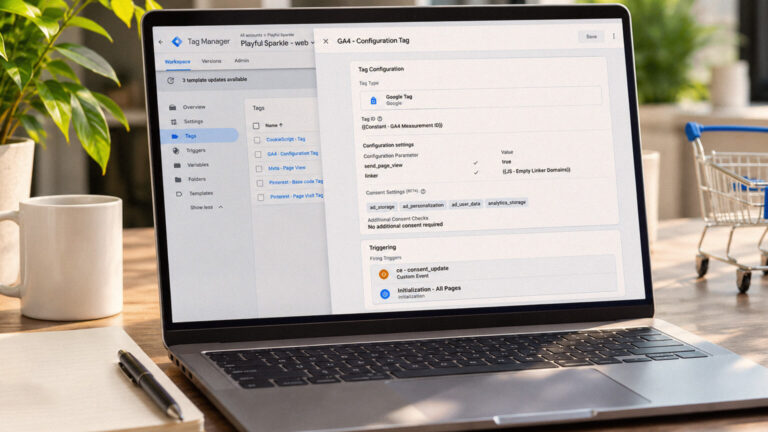
Learn how to structure ecommerce data-layer events and configure GTM triggers and GA4 Event tags. The guide covers product interactions, checkout, purchases, refunds, discounts, promotions, lead-generation events, file downloads, and validation with GTM Preview and GA4 DebugView.

Follow the direct JavaScript workflow for sending GA4 ecommerce events with gtag(). The guide covers the items array, transaction IDs, item discounts, promotions, lead-generation events, file downloads, custom item parameters, and validation with Tag Assistant and DebugView.
Learn how GA4 measures product interactions throughout the shopping journey, from product lists and cart updates to checkout, purchases and refunds. Explore event-level and item-level parameters, the items array, transaction values, discounts, promotions, custom parameters, and the differences between gtag.js and Google Tag Manager.

