Let’s Build Something Great
Tell us about your goals and request a free project estimate.


Product labels identify products, communicate essential information, and provide customers with details about what they are purchasing. They also contribute to brand recognition and help distinguish individual products within a competitive market.
However, designing a label for a bottle of shampoo is different from designing one for a food package, household cleaning product, textile item, or electronic device. Each product category has different information requirements, physical conditions, and technical constraints.
Some labels primarily communicate product names, ingredients, and usage instructions. Others must display safety information, hazard pictograms, material composition, traceability details, or specific regulatory markings.
Effective label design starts by understanding these requirements. The visual identity and information hierarchy can then be developed around the available space, chosen material, and production method.
A product label is often one component of a larger packaging system. While packaging design considers the complete structure, appearance, and functionality of the package, label design focuses on the information and visual elements presented on a particular surface.
A product label has two closely connected responsibilities: communication and identification.
From a branding perspective, it needs to represent the product and establish a recognisable relationship with the company. From a practical perspective, it needs to communicate accurate information in a format that customers can understand.
The available space can be extremely limited. A small cosmetic container may need to accommodate several languages, ingredients, precautions, and manufacturer details. A food label may require a nutrition declaration and highlighted allergen information. A cleaning product may need prominent hazard pictograms and safety statements.
These differences mean that a universal label template is rarely suitable for every product.
Packaging design considers the complete package, including:
Label design focuses on the visual and informational content applied to the product or its packaging.
This content can appear on a self-adhesive label, a wraparound label, a shrink sleeve, a printed carton panel, or directly on the product surface.
Both disciplines need to work together. The label must fit the physical package, while the packaging structure must provide enough suitable space for its information.
Before designing the artwork, establish which information must appear on the label and which regulations apply.
Start by identifying:
A label designed for the Slovak market may need different language versions or additional national requirements when the same product is sold in another EU Member State or exported outside the European Union.
Divide the content into two groups before developing the visual layout.
Mandatory information includes details required by the applicable product legislation. Its wording, presentation, position, and minimum size may be regulated.
Optional information includes brand messages, promotional descriptions, additional product benefits, decorative elements, and other supporting content.
This distinction matters because optional marketing messages should never reduce the visibility or readability of mandatory information.
Do not finalise a label based on an incomplete product specification. The responsible business should confirm the required information and approved wording before the graphic design is completed.
Product labels need an organised structure that allows customers to identify the product and locate relevant information.
The available space should be allocated according to the product’s requirements rather than filled with elements in the order they were supplied.
A practical hierarchy may include:
The actual priority depends on the product category and legislation. For some products, safety information or mandatory declarations must receive more prominence than ordinary marketing content.
The main display area should make the brand and product easy to identify. Supporting areas can accommodate detailed information such as ingredients, instructions, warnings, manufacturer details, and technical specifications.
This separation helps maintain a clear visual presentation without removing important information.
A label does not necessarily have to use separate front and back panels. Bottles, tubes, jars, and irregularly shaped containers may require wraparound layouts or multiple label positions.
The important point is to plan the complete information structure before assigning individual elements to the available space.
The product category determines which information must be displayed and how the label should be organised. The following examples focus on the requirements relevant to products marketed in the European Union.
Food labels need to communicate information that allows consumers to understand the product, assess its contents, and make informed choices.
Regulation (EU) No 1169/2011 establishes general food information and labelling requirements for products intended for final consumers. Depending on the product, mandatory information includes:
Certain categories of food have additional requirements. The applicable rules must therefore be checked for the specific product rather than inferred from another food label.
The EU food information rules require allergens present in the product to be emphasised in the ingredients list. Designers can use a different typeface, style, or background to distinguish the relevant terms from the remaining ingredients.
The emphasis must remain clear and consistent. Decorative styling should not make the allergen information difficult to identify.
Most prepacked foods require a nutrition declaration showing energy value and specified nutrient quantities. This information normally uses a clear tabular format, although a linear format may be permitted when the available space is insufficient.
Food information also has specific typography requirements in the EU. Mandatory particulars generally need an x-height of at least 1.2 mm. For packaging whose largest surface area is below 80 cm², the minimum x-height is 0.9 mm.
These measurements refer to the x-height of the printed characters, not simply the nominal point size selected in design software.
Cosmetic products include skincare, haircare, body care, perfumes, makeup, and similar products.
Their labels need to accommodate the product’s identity, responsible business details, content, usage precautions, and ingredient information.
Under Article 19 of EU Regulation (EC) No 1223/2009, cosmetic product containers and packaging must carry specified information in indelible, easily legible, and visible lettering.
This includes:
Cosmetic products with a minimum durability exceeding 30 months generally do not need a minimum durability date. Instead, the period after opening must be indicated when relevant to the product’s safe use.
Cosmetic products often use curved or narrow containers with limited printing areas. This creates challenges when several information fields need to fit on a small label.
Use a clear layout, consistent alignment, and readable typography. Consider whether a larger label, fold-out label, secondary packaging, or another permitted format is suitable.
Do not reduce text size simply to make a preferred graphic layout fit. The regulatory requirements and readability need to determine the layout.
Cleaning agents, detergents, solvents, and other hazardous chemical mixtures require a different approach because their labels may need to communicate risks and protective measures.
Under the EU Classification, Labelling and Packaging Regulation (CLP), applicable labels may require:
The exact content depends on the classification of the substance or mixture. The appropriate pictograms and statements must be determined from the product’s classification, not selected as decorative graphic elements.
Chemical packaging also has functional restrictions. Under CLP, packaging for hazardous substances and mixtures supplied to the general public must not resemble food, animal feed, medicinal products, or cosmetics, or otherwise mislead consumers.
Designers should therefore treat safety information as a core part of the label structure. It must remain identifiable and legible within the applicable regulatory format.
Textile labels communicate the composition of fabrics and materials used in clothing and other textile products.
EU Regulation (EU) No 1007/2011 establishes requirements for textile fibre names and related labelling. Textile products containing several fibres generally need to identify the constituent fibres and their percentages by weight in descending order.
The regulation also controls the fibre names that may be used to describe textile composition. Terms such as “100%”, “pure”, or “all” have specific conditions and cannot be applied indiscriminately to mixed-fibre products.
For these labels, clarity and accurate terminology are more important than decorative complexity.
The information needs to remain legible at the actual label dimensions and suitable for the garment’s expected use. Material selection should also consider repeated washing, abrasion, contact with skin, and the chosen attachment method.
Electronic devices and other regulated products may require manufacturer details, model identification, batch or serial information, warnings, instructions, and specific conformity markings.
CE marking is a relevant example in the European Economic Area. It is compulsory only for product categories covered by EU harmonisation legislation that requires it. It must not be added to products that are outside the applicable rules.
CE marking is also not a general quality award or a decorative indication of product origin. It represents the manufacturer’s declaration that the product meets the applicable EU requirements.
When designing labels for electronic or technical products, leave sufficient space for required identification and traceability details. Check the applicable product legislation before deciding which symbols, statements, or markings belong on the finished product.
Typography and colour influence how easily customers can identify information and distinguish between product variants.
The visual style should remain consistent with the brand while adapting to the product category and available space.
Establish clear roles for:
Use a limited number of typefaces and consistent font weights. Decorative fonts can work for brand names or selected display elements, but they are usually unsuitable for dense technical content.
Check the actual printed size rather than relying on how the text looks on a large monitor.
Text needs enough contrast against its background to remain readable under realistic lighting and viewing conditions.
Avoid placing small text over complex images, textured surfaces, or backgrounds with inconsistent colours.
For food and regulated product labels, follow the applicable legal presentation and readability rules. These requirements take priority over purely aesthetic decisions.
Colour coding can help customers distinguish flavours, formulas, sizes, or product types.
A controlled system might retain the same brand colours and logo placement across a product range while changing a secondary colour for each variant.
Do not rely exclusively on colour to communicate important differences. Product names and other clear identifiers should remain available, including for customers who have difficulty distinguishing certain colours.
The chosen label material affects durability, appearance, adhesion, and production costs.
A label that works well on a paperboard box may not perform reliably on a curved plastic bottle or a glass container exposed to moisture.
Paper labels are often suitable for dry products and standard retail packaging. They support a wide range of print finishes but may require additional protection when exposed to moisture or abrasion.
Polypropylene labels offer resistance to moisture and are commonly used on bottles, personal care products, and other containers.
Polyethylene labels are flexible and can suit containers that bend or deform during use.
Polyester labels are useful where resistance to abrasion, chemicals, heat, or demanding handling conditions is important.
The final choice depends on the specific material grade, adhesive, printing process, and conditions in which the product will be stored and used.
Common production formats include:
Each format has different requirements for artwork dimensions, positioning, material behaviour, and application.
For example, a shrink sleeve must accommodate distortion during the shrinking process. A pressure-sensitive label needs an adhesive compatible with both the label material and the container surface.
Before approving a material, test it under the conditions the finished product will experience.
Consider moisture, refrigeration, temperature changes, oils, chemicals, friction, sunlight, and repeated handling.
A label that begins to lift, wrinkle, fade, or become unreadable can undermine the product’s presentation and create practical problems.
Labels often contain information that must be machine-readable or change between production batches.
Barcodes, QR codes, batch identifiers, production dates, expiry dates, and serial numbers need dedicated space in the artwork.
A barcode must meet the relevant technical specifications. Its dimensions, contrast, quiet zones, and placement affect whether a scanner can read it.
GS1 identifies several common barcode problems, including insufficient quiet zones, poor contrast, incorrect dimensions, reduced barcode height, and unsuitable positioning on curved or irregular surfaces.
Avoid placing barcodes over folds, seams, edges, highly textured surfaces, or areas where the package may distort the symbol.
Always test the barcode on the printed label and finished package. A barcode that appears correct in the design file may still fail during scanning.
QR codes can direct customers to product information, instructions, support pages, digital content, or additional brand resources.
They should not be added simply because there is unused space. Define what the destination provides and make sure the information remains available and maintained.
A QR code also needs sufficient contrast, a suitable printed size, clear surrounding space, and testing on the final material.
It should not be assumed to replace mandatory printed information unless the applicable legislation specifically allows that approach.
GS1 has established an industry goal for retail point-of-sale systems to support selected GS1-standard 2D barcodes, alongside existing linear barcodes, by the end of 2027.
This is an industry transition target, not a general legal requirement for every product label. Existing linear barcodes will continue to be relevant during the transition. Businesses should confirm the requirements of their retailers and supply chains before changing their barcode strategy.
The final artwork must reflect the label’s physical dimensions and the requirements of the selected production method.
Start with the approved label dimensions and the manufacturer’s technical specifications. Account for cutting tolerances, bleed, safe zones, curved surfaces, seams, and areas that must remain free of important text.
Before sending the artwork to production, check:
Request a physical proof where possible. Inspect the label at its intended size and on the actual container.
Check whether the text remains readable, the colours reproduce correctly, the label aligns with the package, and the adhesive performs as expected.
Products sold in several countries may require multiple languages on a single label.
This affects the available space and the amount of text that needs to fit within the design.
Do not assume that translations will occupy the same space as the original wording. Some languages require longer phrases, which can change line breaks, alignment, and the overall information hierarchy.
For food products, EU rules require mandatory information to appear in a language easily understood by consumers in the Member States where the product is marketed. Member States may also stipulate the use of one or more official EU languages.
Plan multilingual content before finalising the layout. Expanding the artwork after approval can create avoidable production changes.
Labels increasingly use statements about recycled content, recyclability, biodegradability, and other environmental characteristics.
These claims need accurate wording and appropriate evidence.
Directive (EU) 2024/825 entered into application on 27 September 2026. Its rules strengthen consumer protection against misleading environmental claims and unreliable sustainability labels in business-to-consumer marketing.
Avoid broad claims such as “environmentally friendly” or “green” without suitable substantiation and clear qualification. Do not use environmental symbols that imply certification or independent approval when no such basis exists.
Several problems repeatedly affect label quality and usability:
Product label design requires a balance between brand communication, information hierarchy, technical production, and product-specific requirements.
The correct approach depends on what the product is, where it will be sold, and how customers will use it. A food label has different information and typography requirements from a cosmetic label, chemical hazard label, or textile composition label.
Start by confirming the required content and relevant regulations. Then develop the visual hierarchy, select appropriate typography and materials, and prepare the artwork for the actual production process.
A well-designed label should make the product identifiable, present its information clearly, and remain reliable throughout storage, distribution, and use.
For a broader look at how structure, visual identity, materials, and shelf presence work together, see the companion article, How to Design Product Packaging That Stands Out on the Shelf.
Food labelling and information requirements
Cosmetic, chemical, and textile labelling
Barcodes and product identification
Environmental claims and product markings
Playful Sparkle has engineered digital products since 2004. Our Branding & Strategy and Graphic Design services help businesses develop consistent brand identities and communicate effectively across their products and digital channels.


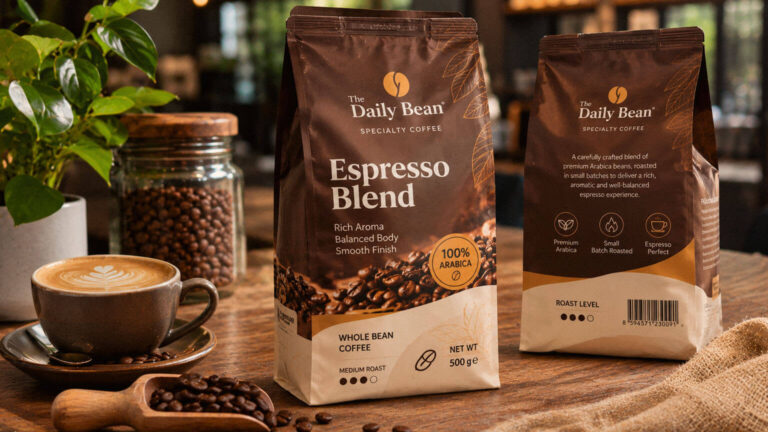
Effective packaging combines brand recognition, product information and shelf differentiation with structural protection and practical usability. Explore competitor analysis, visual hierarchy, material selection, finishing techniques, EU packaging requirements and physical testing before production.
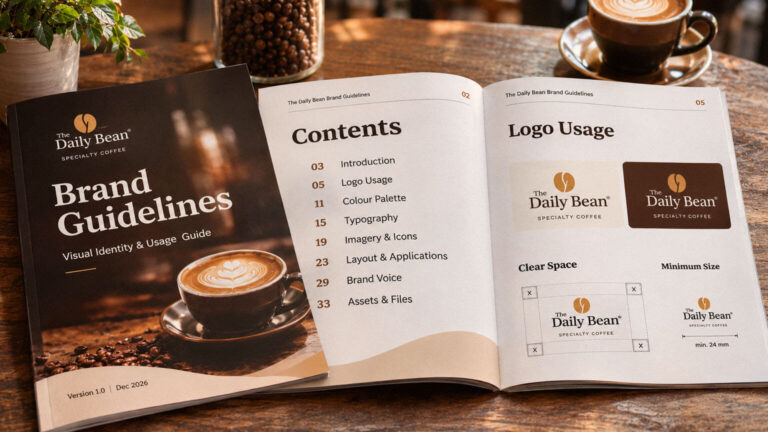
To design a brand guidelines document, define the brand foundations, logo rules, colour specifications, typography, imagery, tone of voice and channel requirements. Learn how to document approved assets, accessibility rules, usage examples and version control.
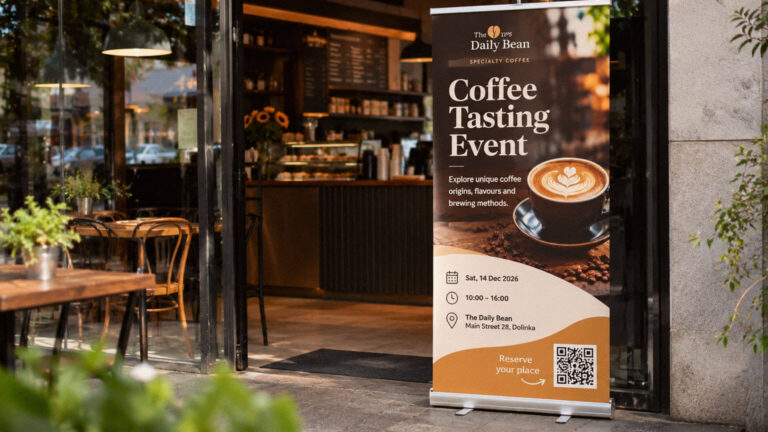
Design a Retractable Banner around the actual stand specifications, including its visible display area and concealed bottom allowance. Learn how layout, typography, printing materials and production methods affect the finished event display.

