Let’s Build Something Great
Tell us about your goals and request a free project estimate.


robots.txt rules carefully before blocking AI crawlers.The way people discover websites is changing. Search engines are no longer just showing links in response to user queries. Google’s AI Overviews, Bing’s Copilot, and ChatGPT with real-time browsing all give users instant, conversational answers-often without requiring a visit to the source website.
According to HubSpot’s CMO Kipp Bodnar, AI-powered search now accounts for 7% to 12% of their website visitors, and that figure is growing .
This guide explains what AI search optimization is, how AI search engines actually work, and what you need to do to stay visible. We draw on research from Princeton University, Search Engine Land, Rank Math’s analysis of ChatGPT citations, and verified industry data from 2025–2026.
AI search refers to search experiences powered by large language models (LLMs) that generate conversational, synthesized answers rather than simply returning a list of ranked links.
| Platform | Operator | How It Works |
|---|---|---|
| ChatGPT Search | OpenAI | Uses Bing for live web data + training data; main source for most web citations |
| Google Gemini / AI Mode | Uses Google Search, digitized books, YouTube; conducts multi-query “fan-out” searches | |
| Perplexity | Perplexity AI | Uses PerplexityBot + Google via SerpApi; has its own ranking system with L3 reranking |
| Copilot | Microsoft | Uses Bing Search, Common Crawl |
| Claude | Anthropic | Uses Brave Search |
| Brave Search AI | Brave | Uses own search index |
Traditional search engine: Returns a ranked list of links based on keyword matching and backlink authority. Users must click through to find answers.
AI search engine: Generates a synthesized answer from multiple sources, then cites them. The user often gets the answer without clicking.
LLM (Large Language Model): The underlying AI that understands language, retrieves information, and generates responses. Not necessarily connected to the live web.
AI assistant: An LLM with access to tools (web search, memory, user context) that can act on behalf of the user.
AI agent: An AI that can take actions (book tickets, make purchases) beyond just answering questions.
| Factor | Traditional SEO | AI Search Optimization |
|---|---|---|
| Goal | Rank pages | Get cited in generated answers |
| Primary signal | Keywords, backlinks | Authority, context, entities, relevance |
| Query length | 4–6 words average | 40–60 words average |
| User behavior | Click through to website | Often consumes answer without clicking |
| Click-through rate | ~30–40% on page one | ~60–70% lower for AI Overviews |
| Competitive advantage | Best backlink profile | Strongest entity-to-brand association and semantic clarity |
On traditional search, keywords are enough. On AI search, the context around those keywords matters more.
People who argue this point to evidence that AI systems largely pull from existing search results. Google’s AI Mode, for example, runs multiple searches and retrieves the top results . Perplexity’s ranking has been shown to heavily weigh traditional signals like backlinks.
“Performing SEO for Google is automatically performing optimization for Google’s AI.” – Chris Smith, Search Engine Land
This camp points to new signals: entity relationships, brand bias, semantic clarity, and citation selection models that don’t behave like traditional ranking. GEO research from Princeton showed that certain optimizations can boost visibility by up to 40% in generative engine responses-significantly more than traditional SEO tactics alone .
A 2026 analysis published by Sitebulb, featuring research from Dan Petrovic (founder of DEJAN) and Jes Scholz, concluded that AI search has added a new layer of complexity on top of traditional search, but it hasn’t replaced the foundations .
Separate ranking signals into three categories:
| Category | Signals |
|---|---|
| Traditional SEO | Crawlability, speed, indexability, metadata, structured data |
| AI-Specific Signals | Entity relationships, semantic clarity, citation-worthy content, question-answering, factual consistency |
| Shared Signals | Expertise, trust, authority, freshness, originality |
Based on analysis by Dan Petrovic and Jes Scholz, the AI search process follows a multi-step pipeline:

Why this matters: You might have a thousand-word article, but the AI might only see a couple of hundred words from it. You won’t know which parts unless you test.
Architecture diagram:
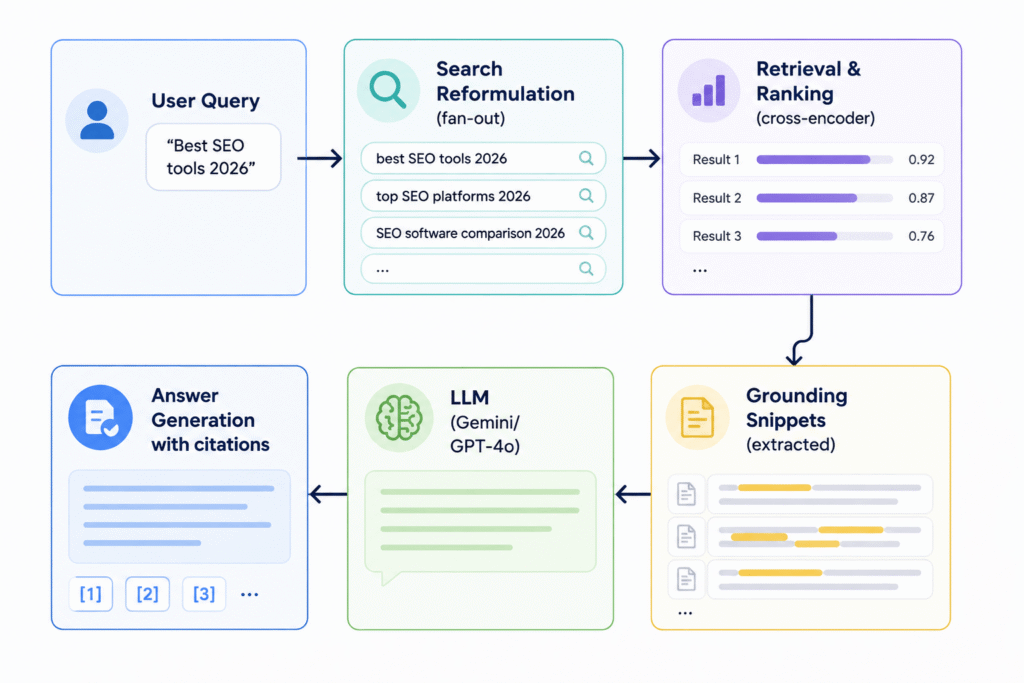
| Term | Explanation |
|---|---|
| Embeddings | Numerical representations of text that capture semantic meaning |
| Vector databases | Stores embeddings for fast similarity search |
| RAG (Retrieval-Augmented Generation) | Retrieves relevant documents before generating an answer |
| Knowledge graph | A database of entities and their relationships |
| Grounding | The process of linking a generated answer to its source documents |
| Query fan-out | Expanding one query into multiple related searches |
AI systems prioritize sources that are:
Main-cited sources are the primary sources that shape an AI’s answer. Rank Math’s research found that 100% of products mentioned in ChatGPT answers appear in the main-cited sources .
| Platform | Own Crawler? | Primary Source | User-Agent | Real-Time? |
|---|---|---|---|---|
| ChatGPT | Yes (GPTBot, OAI-SearchBot) | Bing + training data | GPTBot, OAI-SearchBot, ChatGPT-User | Yes |
| Gemini | Yes (Googlebot) | Google Search | Googlebot | Yes |
| Claude | Yes (ClaudeBot) | Brave Search | ClaudeBot, Claude-SearchBot | Yes |
| Perplexity | Yes (PerplexityBot) | Own index + SerpApi | PerplexityBot | Yes |
| Google AI Mode | Yes (Googlebot) | Google Search | Googlebot | Yes |
| Copilot | Yes (BingBot) | Bing Search | bingbot | Yes |
| Meta AI | Yes (Meta-ExternalAgent) | Google Search + Facebook/Instagram | meta-externalagent | Yes |
Source: Cloudflare Bot Documentation
Each platform’s primary web source differs. While Google Gemini pulls from Google Search, ChatGPT uses Bing and training data. This means you need visibility on both Google and Bing to maximize AI citations .
| Crawler | Operator | Purpose | robots.txt support | Documentation |
|---|---|---|---|---|
| GPTBot | OpenAI | AI model training | Yes | OpenAI Docs |
| ChatGPT-User | OpenAI | Real-time answers | Yes | OpenAI Docs |
| OAI-SearchBot | OpenAI | ChatGPT Search indexing | Yes | OpenAI Docs |
| Google-Extended | AI model training | Yes | ||
| ClaudeBot | Anthropic | AI model training | Yes | Anthropic Docs |
| PerplexityBot | Perplexity | Search indexing | Yes | Perplexity Docs |
| Bytespider | ByteDance | AI model training | Yes | TikTok/ByteDance |
| Meta-ExternalAgent | Meta | AI model training | Yes | Meta |
| CCBot | Common Crawl | Web archiving | Yes | Common Crawl |
All major AI crawlers support robots.txt and can be blocked if required .
Do not block essential AI crawlers if you want your content cited. Rank Math’s analysis found that older, well-optimized content from training data still appears in ChatGPT answers, even when it’s not in Google or Bing’s live results .
Yes, via:
robots.txt:
User-agent: GPTBot
Disallow: /
HTTP headers:
X-Robots-Tag: GPTBotMeta robots:
<meta name="robots" content="GPTBot">Pros: Protects copyrighted content, prevents brand dilutionCons: Blocks your brand from being discovered, reduces citations, hurts AI search visibility
Based on analysis across multiple platforms :
| Signal | Importance | Evidence |
|---|---|---|
| Website quality | High | Core foundation for all AI citation |
| Structured data | High | Makes content machine-readable |
| Clear authorship | High | Builds trust and authority |
| Topical authority | Critical | L3 reranker uses this for Perplexity |
| Entity recognition | High | AI systems snap to entity associations |
| Semantic HTML | High | Headings, lists, definitions |
| Content freshness | High | 86% of main-cited sources were written/updated in the same year |
| Citation frequency | Medium | ChatGPT weighs frequency of mentions |
| Source reputation | High | Manual domain lists (Amazon, GitHub) get boosts |
| Technical quality | High | Page speed, mobile, HTTPS |
| Brand recognition | Very High | Models are biased toward known brands |
“Models are just statistical machines and they snap to their probabilities. You want to be the brand that the model snaps to when it’s associating things with a certain entity or product.” – Dan Petrovic
Structured data (Schema.org) is essential for AI search optimization. According to Japanese research, implementing structured data on service pages increased AI crawler access by approximately 10× .
| Schema Type | Why It Matters |
|---|---|
| Organization | Defines entity relationships, brand identity, social profiles |
| Person | Associates content with a specific author |
| Article | Marks content as original, published, with dates |
| FAQ | Directly answers user questions |
| HowTo | Provides step-by-step instructional content |
| Product | Defines product attributes, pricing, reviews |
| Review | Social proof signal |
| Breadcrumb | Site structure |
| Video / ImageObject | Multimedia discoverability |
“Structured data provides a machine-readable meaning to page information. For example, ‘Mitsue-Links’ as a string becomes defined as an ‘Organization’ with attributes such as business type.”
| Metadata Type | Why It Matters for AI Search |
|---|---|
| Title | Helps define page topic and entities |
| Description | Used by some AI systems for summary preview |
| Open Graph | Helps AI understand social sharing context |
| Twitter Cards | Same as Open Graph |
| Canonical | Prevents duplicate content confusion |
| hreflang | Defines language and regional targeting |
| Robots | Controls indexing and crawling |
| JSON-LD | Structured data in the <head> |
Entity SEO is the practice of optimizing for named entities-people, organisations, products, concepts-and their relationships.
sameAs linking to Wikipedia, Wikidata, Facebook, LinkedInPerson entitiesA German sports equipment brand had a problem: AI models wouldn’t recommend them to non-German customers despite good rankings. The fix took two approaches :
Result: The fixes didn’t show results until a new model version was released-showing that model updates are critical for AI visibility.
AI systems value the same trust signals that Google does :
| E-E-A-T Component | Why It Matters for AI |
|---|---|
| Experience | First-hand knowledge signals authenticity |
| Expertise | Demonstrated knowledge in the domain |
| Authoritativeness | Other sources cite you; recognized as an authority |
| Trustworthiness | YMYL queries require high trust for AI citations |
Dan Petrovic’s research suggests that AI systems apply a practical ceiling on how much of a given page feeds into the grounding context :
The solution is not shorter content-it’s more information-dense content. Structure with clear headings so extractive summarisation has the best chance of pulling representative passages.
| Requirement | Why It Matters |
|---|---|
| HTTPS | Security signal; AI crawlers respect secure sites |
| Fast loading | 10× increase in AI crawler access with optimized pages |
| Mobile-responsive | Core for crawling and user experience |
| Accessible | Semantic HTML is also machine-readable |
| Semantic HTML | Headings, lists, definitions used for extraction |
| Internal linking | Helps crawlers discover all pages |
| Canonical URLs | Prevents duplicate content confusion |
| XML sitemap | Essential for crawler discovery |
| Robots.txt | Controls crawler access |
| Structured data | Adds machine-readable meaning |
| Valid HTML | Reduces parse errors |
| HTTP headers | Controls caching, security, and crawler instructions |
Unlike Google rankings, AI visibility has no unified dashboard. Monitor these signals:
| Metric | How to Track |
|---|---|
| ChatGPT citations | Manual searches; use Deep Research function |
| Perplexity mentions | Search for your brand in Perplexity |
| Google AI Overviews | Look for your brand appearing in AI Overview snippets |
| Brand mentions | Use Mention or BuzzSumo |
| Referral traffic | Google Analytics → Referrals from openai.com, chatgpt.com, perplexity.ai |
| Search Console | Monitor impressions in AI Mode (Google) |
| Server logs | Check for AI crawler visits (GPTBot, PerplexityBot, etc.) |
Use ChatGPT’s Deep Research function and simulate a customer query. Does your business appear? If not, ask ChatGPT why-it will highlight what’s missing, providing a valuable guide to improving your content .
| Myth | Reality |
|---|---|
| “Keywords don’t matter anymore.” | They matter-just in the context of entities and questions |
| “Backlinks are dead.” | Backlinks remain important for authority |
| “AI ignores structured data.” | Structured data improves machine-readability |
| “Schema guarantees citations.” | It only increases likelihood |
| “You must write for AI.” | Write for humans; AI reads semantic structure |
| “AI replaces SEO.” | AI search extends SEO with new signals |
| “AI reads PDFs better.” | AI primarily reads HTML |
| “AI only uses Bing.” | Different platforms use different primary sources |
| Mistake | Why It Hurts |
|---|---|
| Keyword stuffing | AI systems detect semantic incoherence |
| AI-generated spam | Low-quality content won’t be cited |
| Thin content | No value to extract |
| Missing entities | Weak knowledge graph association |
| Outdated information | 86% of citations go to fresh content |
| Broken schema | Invalid structured data is ignored |
| No citations | AI can’t verify claims |
| No expertise | YMYL queries won’t cite |
| Poor page structure | Extractive summarisation can’t find relevant passages |
Perplexity’s Comet browser and ChatGPT Pulse are examples of AI agents that can take actions-book flights, make purchases-on behalf of users . This represents a shift from search to action.
ChatGPT Pulse builds a “personality map” of users by tracking application usage and recommends content accordingly-making traditional ranking less relevant .
Voice-based interfaces (Google’s Project Astra) and vernacular language search will change how content is discovered .
“Human employees learn on the job-some CEOs even started as interns-but today’s agents remain largely static pieces of probabilistic software. Work like this paper is an important step toward changing that.” – Akash Srivastava, IBM
AI Search Optimization is not a replacement for SEO. Instead, it extends technical SEO with stronger emphasis on:
Sites that already follow modern technical SEO and publish authoritative, well-structured content are generally in the strongest position to appear in AI-generated search experiences.
The shift from “what does the user want” to “what does the user actually need” underpins the transition from traditional SEO to AI search optimization. Those who adapt will thrive; those who don’t will watch their traffic gradually decline .
Need help optimizing your website for AI search? Playful Sparkle has been engineering digital products since 2004, offering SEO & Digital Marketing, Web Development, and Branding & Strategy services. Our team can help you adapt your content, technical infrastructure, and structured data for AI-driven search visibility. Contact us to discuss how we can help you stay visible in the AI search era.



Learn how eight compromised eMudhra private keys put website trust at risk, which systems may be affected, and what businesses, developers, and users should do.

Facebook introduced link-sharing limits for selected Pages in 2026. Learn how the restrictions affect businesses and how your website, email subscribers, and other channels can help you find customers beyond Facebook.

On October 21, 2026, two critical PHP vulnerabilities, CVE-2026-109618 and CVE-2026-109619, were disclosed, enabling potential unauthenticated remote code execution. Learn which PHP versions are affected, how the flaws impact WordPress and other websites, and how to secure your servers.

